
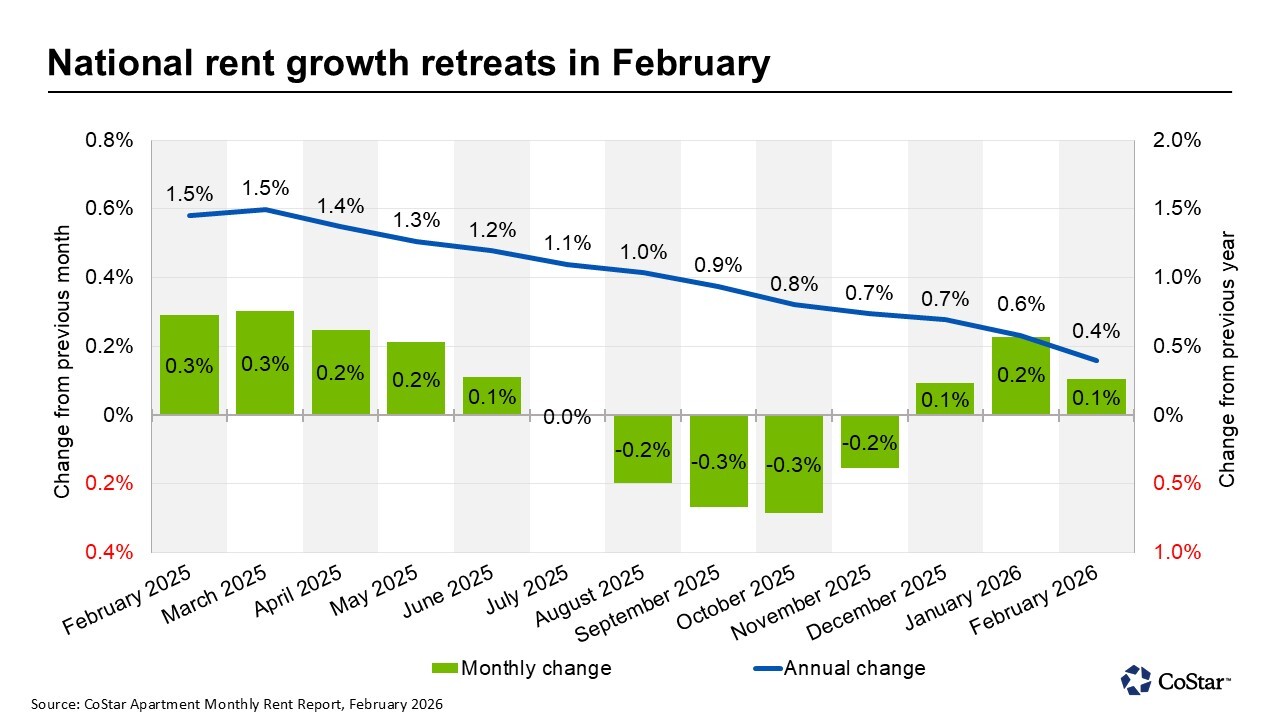
U.S. apartment rents increased in February, with the national average increasing to $1,716, a 0.1% increase from January’s upwardly revised figure of $1,714, according to Apartments.com's latest report on multifamily rent trends.
The monthly rent increase continues the trend of rising monthly rent changes that began in December 2025, but at a moderated pace. Prior to December, rents were flat or falling for five consecutive months. Annual rent growth eased marginally to 0.4% in February 2026 from 0.6% in the prior month and down from a 1.5% increase in February 2025.
Apartment rents generally follow a seasonal pattern, accelerating in the spring and slowing in late summer and fall. Rents in February typically build on increases that begin with the December inflection.
While the rent change in February 2026 was positive, the increase was modest relative to typical February seasonality observed from 2010 to 2025, when rents increased by an average of 0.3%.
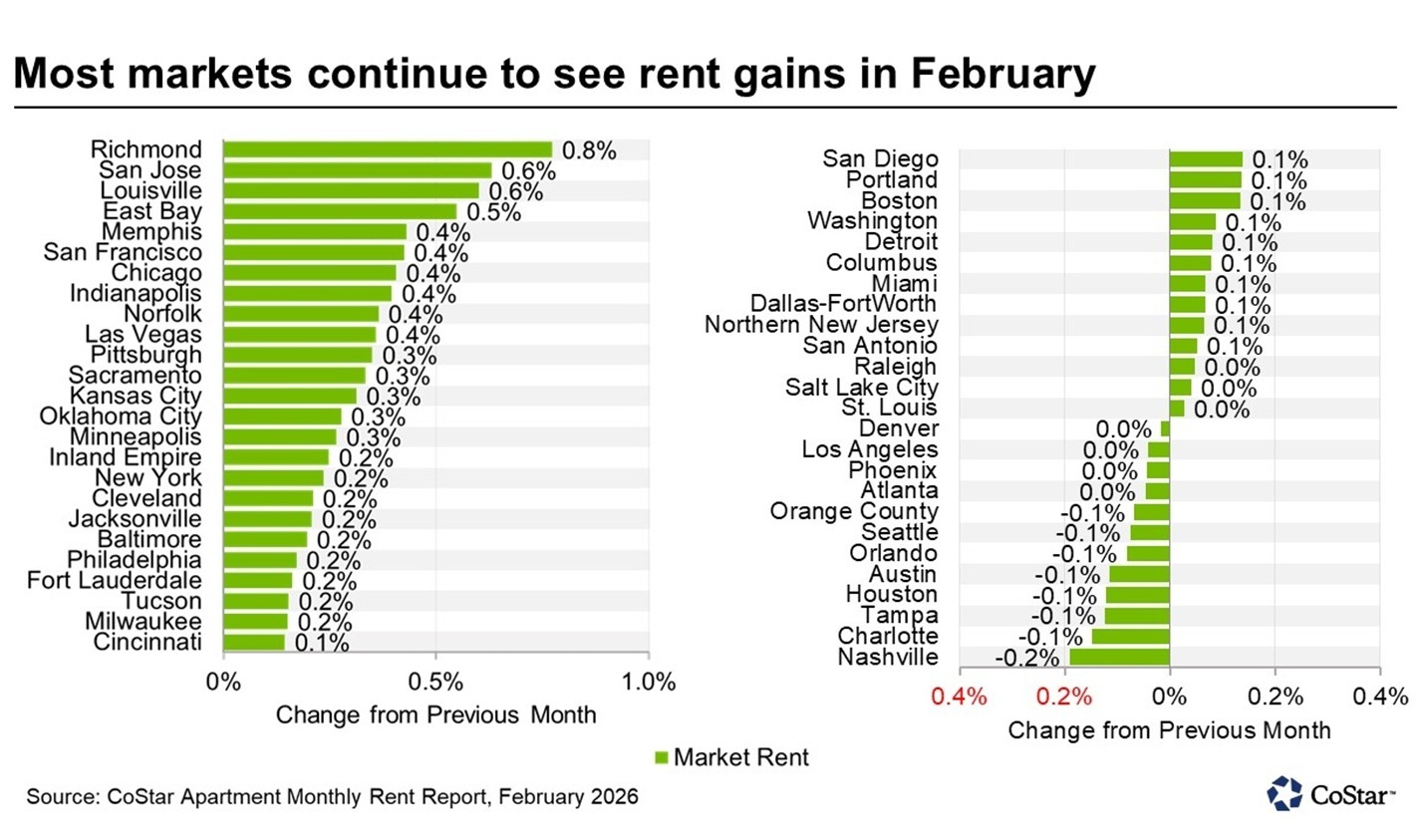
Supply pressures remain elevated and continue to temper rent momentum, resulting in uneven early-year gains that remain below typical February seasonal averages.
Across the U.S., 38 of the top 50 metropolitan areas posted rent increases, down from 42 in January. Areas posting the highest month-over-month rent increases were Richmond, Virginia, at 0.8%, San Jose, California, at 0.6% and Louisville, Kentucky, at 0.6%.
The steepest average monthly declines occurred in Nashville, Tennessee, down 0.2%, followed by Charlotte, North Carolina, Tampa, Florida, Houston, Austin, Texas, Orlando, Florida, Seattle and Orange County, California, where apartment rents decreased by an average of 0.1%. Many of these Sun Belt markets face elevated vacancy after newly constructed apartments opened, putting downward pressure on rents.
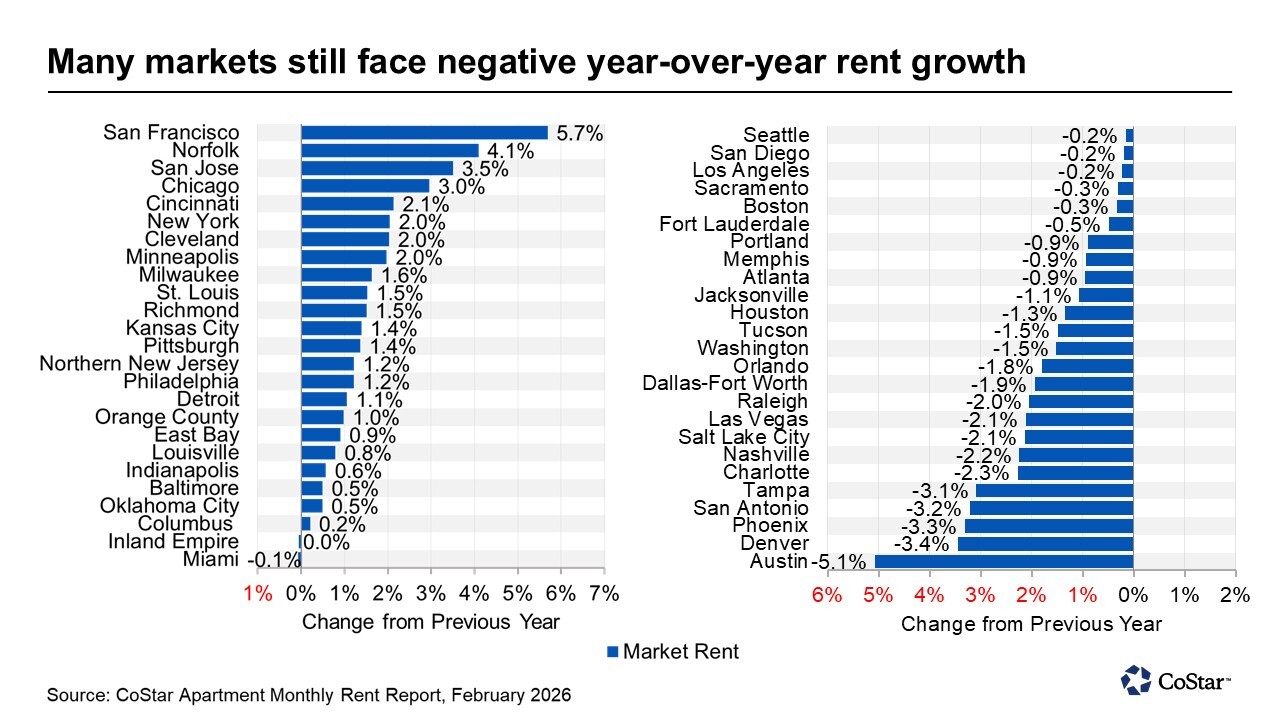
San Francisco posted the strongest annual rent increase at 5.7%, followed by Norfolk, Virginia, at 4.1%, San Jose, California, at 3.5% and Chicago at 3.0%. In contrast, apartment rents in Austin, Texas, recorded a 5.1% decline, while rents in Denver fell 3.4% and rents in Phoenix, Arizona, declined 3.3%, each reflecting oversupply outpacing demand.
These patterns reinforce the broader trends: U.S. apartment markets with the highest levels of new construction are seeing the weakest rent performance, while more supply-constrained areas — particularly in the Midwest and select coastal areas — continue to outperform. In some markets, however, falling employment and softening demand may also be contributing to weaker rent growth.

