
Nicolas Dufour came into federal politics young and left it early, and he says that short but intense experience shaped how he governs today.
Dufour won the riding of Repentigny in the 2008 federal election at age 25, making him one of the youngest MPs in the country at the time. After a single term in the House of Commons, he stepped away from federal politics, later completing graduate studies in municipal management and working in Quebec’s hotel and tourism sector before returning to elected office as mayor of Repentigny in 2021.
“I never planned on municipal politics at first,” Dufour told a Montreal audience at a recent real estate conference, recounting how his early career moved quickly from Parliament Hill into policy, administration and economic development. “I wanted to understand how cities actually function.”
That perspective now informs how he talks about Repentigny’s future and his belief that the city is well‑positioned to benefit from what he sees as growing frustration with downtown Montreal.
People and companies are turning away from the city centre, Dufour said, not because they want to leave the region, but because they want access without friction. “More and more, people don’t want to go downtown Montreal,” Dufour said. “They want to be close enough to be in the market, but not have to deal with the constraints that come with locating in the core.”
He made those remarks at the Montreal Real Estate Forum, speaking to a roomful of developers, investors and brokers about how Repentigny is approaching growth as developable land inside the city becomes scarce.
Repentigny, home to about 90,000 residents, sits east of Montreal at the junction of highways 40 and 640. Long viewed primarily as a residential suburb, the city has little room left to expand outward, pushing redevelopment and density to the forefront of its planning strategy.
Densification goes askew
Dufour said that reality has forced Repentigny to confront not just how much it builds, but how it builds. He has been openly critical of how densification was handled before he took office, particularly along the St. Lawrence River.
“In the last few years, densification was badly done,” he said. “We built very tall towers right on the river. We deprived people of that jewel, and it created a backlash against densification among citizens.”
That experience, he said, left residents wary of height and reinforced the need for a different approach, one that ties density to access, services and public space rather than imposing it simply to increase unit counts.
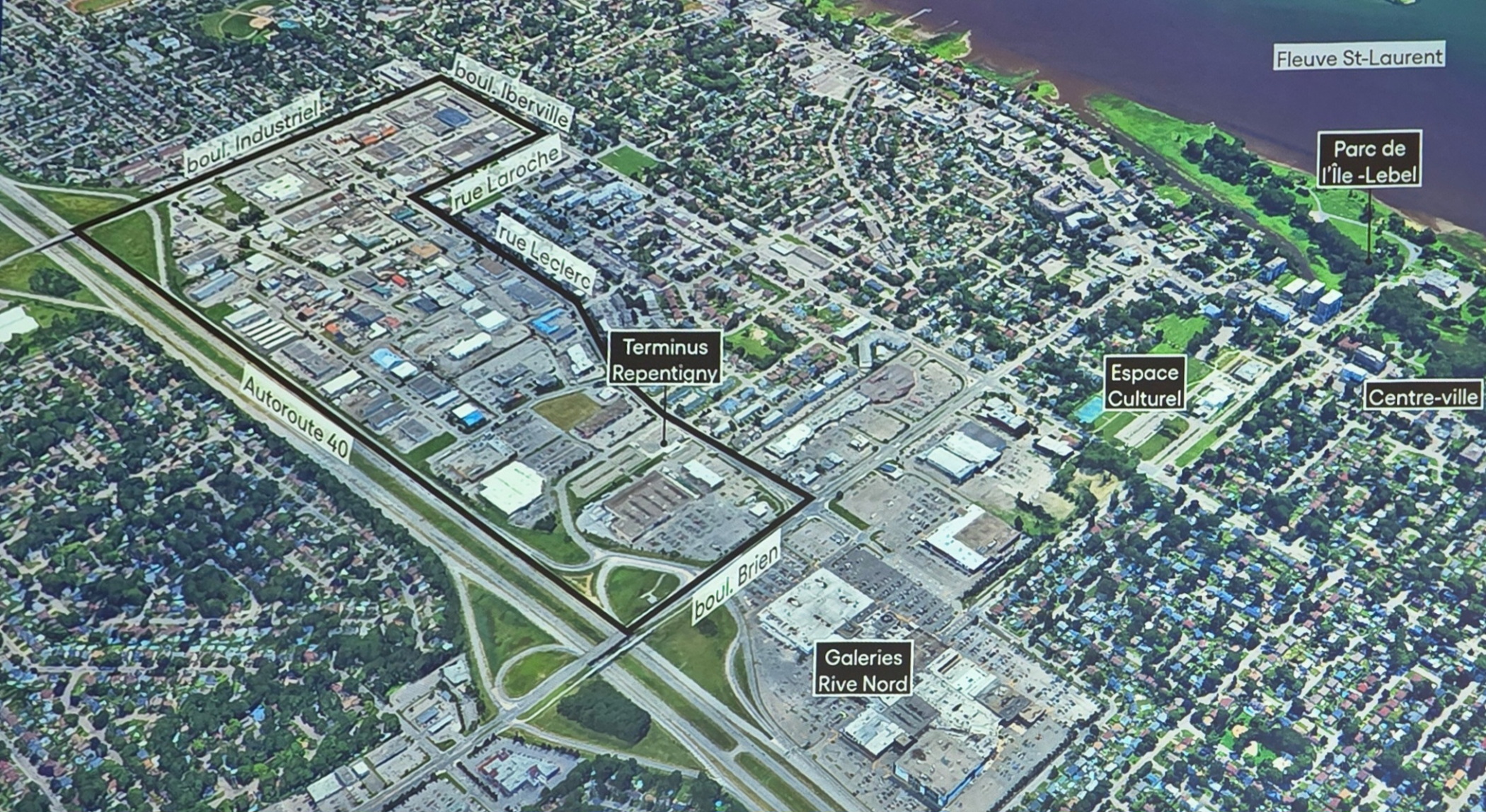
The clearest expression of that approach is Avancia, a large redevelopment district planned on the site of Repentigny’s existing industrial park along Highway 40. Covering roughly 6 million square feet, Avancia is designed to accommodate up to 5,000 housing units alongside office, commercial and light industrial space.
In Avancia, zoning rules have been rewritten to simplify development rights. Projects can rise to eight storeys as of right if they include commercial space on the ground floor, with additional height possible through housing‑related agreements. “I’m not an interventionist in economic matters,” Dufour said. “What I want is for the market to organize itself.”
To make that possible, Repentigny has taken on a more active role behind the scenes. The city has spent more than $40 million acquiring land, expanded its use of pre‑emption rights and centralized its development approvals. Dufour said permits can be issued within 30 days for projects that align with the city’s planning objectives. “Time is money,” he said. “If it makes sense, we move.”
Transit is another pillar of how Dufour frames the city’s appeal. He pointed to the province’s announced tramway project, which would link Repentigny to Montreal’s metro network and cut travel times to roughly 25 minutes. Avancia, he said, is planned around a long linear park meant to make the area attractive to workers and businesses as commuting patterns evolve.
“If we want people to come in, we have to create places they actually want to be,” he said. Dufour said Repentigny is now among the fastest‑growing municipalities in Montreal’s outer suburbs even as land constraints tighten. For him, that tension is not a warning sign but a measure of timing. “We prepared for this,” he said. “Now it’s about execution.”