
Competitive Set Guidelines
Competitive Set Guidelines are rules and criteria used to define a group of properties that are considered direct competitors of your hotel. These guidelines help maintain the integrity and accuracy of performance comparisons while protecting proprietary data within the Competitive Set.
If the combination of reporting properties in a Competitive Set violates one of the rules, Competitive Set data may be suppressed, or a Competitive Set may be deleted and no longer available.

Jump to section:
View Other Guidelines
Historical Benchmarking | P&L | Forward STAR
Sufficiency
Property Minimum
A Competitive Set must include a minimum of four participating properties, not including the subject property. Of the four, there must be a minimum of three properties not affiliated with the subject property (i.e. cannot share a parent company, operator or owner with the subject property).
Company Minimum
A Competitive Set must include a minimum of two companies not affiliated with the subject property (i.e. cannot share a parent company, operator or owner with the subject property)
Composition
Property
No single property can account for more than 50% of the total participating room supply of a Competitive Set, excluding the rooms of the subject property and other properties from the same company as the subject property (parent company, operator or owner).
Brand
No single brand (e.g. Fairfield by Marriott, DoubleTree by Hilton) can account for more than 50% of the total participating room supply of a Competitive Set, excluding the rooms of the subject property and other properties from the same company as the subject property (parent company, operator or owner).
Company
No single company (e.g. IHG Hotels & Resorts, Host Hotels & Resorts) can account for more than 70% of the total participating room supply of a Competitive Set, excluding the rooms of the subject and other properties from the same company as the subject (parent company, operator or owner).
Competitive Set Changes
Minimum of Two
A Competitive Set change must include a minimum of two participating properties. The two properties must be open for at least five months and must not be affiliated with the subject property (i.e. cannot share a parent company, operator or owner with the subject property).
Minimum of Two Exceptions
- New Construction Hotels – A newly constructed property can be added to a Competitive Set within five months of its opening.
- Reopened Hotels – When a closed property reopens, it may be added back to the Competitive Set on its own if it was closed for a minimum of 12 months AND is within five months of the property reopen month.
- Non-Participating Hotels – If a property stops participating, the property may be removed from the set on its own if all other conditions (sufficiency and composition) are still met.
- Permanently Closed Hotels – Any property that becomes “permanently closed” can be removed from the set without the need for additional changes.
Isolation Checks
Isolation checks are performed against ALL reports processed (ordered) for a specific subject property and its affiliated companies during the past 12 months, including:
- Existing Competitive Sets
- Competitive Sets of properties in the Competitive Set related to the subject
- Legacy Trend reports
- Legacy Custom P&L reports
- Industry segments
These checks ensure individual property data is not isolated from report to report. Importantly, reports processed and ordered by any company related to the subject property are taken into consideration and can include parent company, operator, owner and/or any agent(s) acting on behalf of a specific property. For example, when a member of the Competitive Set is also under the same parent company, operator or owner as the subject property, then all reports that competitor receives will be compared to the reports the subject property receives.
A change may not be made if data of a single property is isolated in any way.
Multiple Competitive Sets
If a company has more than one Competitive Set, the composition of each set must differ by at least two properties. The two properties cannot be affiliated with the subject property (i.e. cannot share a parent company, operator or owner with the subject property).
Participating Property Definition
If the property is NOT seasonally closed or temporarily closed:
- Data submitted for current month OR
- Data submitted for 3 of the 4 most recent months
If the property IS seasonally closed or temporarily closed:
- Data submitted in the month immediately prior to closing OR
- Data submitted for 3 of the 4 months immediately prior to closing
Noncompliant Competitive Sets
If a Competitive Set violates any of the preceding guidelines, it becomes “noncompliant” and may become immediately deactivated in certain scenarios.
| Scenario | Active | Deactivated |
|---|---|---|
| 3 or fewer participating hotels | Image

| |
| Single Property or Brand room share | Greater than 51% but less than 61% | Greater than 61% |
| Parent, Owner or Operator room share | Greater than 71% but less than 81% | Greater than 81% |
| Set isolates individual property data | Image
|
Competitive Sets that are noncompliant and active continue to be shown in the Benchmark feature of CoStar.
Competitive Sets that are noncompliant and deactivated are suppressed in the Benchmark feature of CoStar, meaning data is not visible.
In both instances, the set is flagged as noncompliant in Comp Set Management. Users have 90 days to bring the set back into compliance. Sets not brought back into compliance within 90 days are deleted and cannot be recovered.
Composite Properties
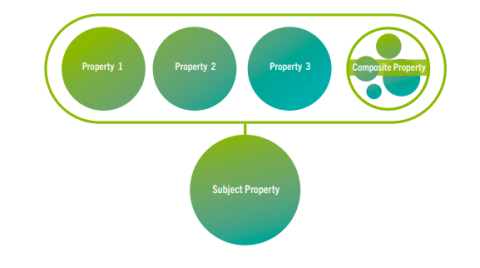
A Composite Property is an aggregate of multiple, anonymous properties that act as one individual property. The hotels that make up this Composite Property are anonymized and chosen automatically by proprietary methodology that weighs objective criteria such as location, performance, class, property size and mix of business.
Competitive Sets including a Composite Property must follow the Competitive Set guidelines. A Competitive Set change may not be made if data of a single named hotel is isolated in any way. Because of the anonymity, the data that makes up the Composite Property cannot be isolated.
Comp Set Changes with a Composite Property
Adding a Composite Property
A Competitive Set can only have one Composite Property. A Composite Property can be added to/removed from a Competitive Set by itself at any time (STR’s “Minimum of Two” rule does not apply here because the data that makes up the Composite Property cannot be isolated by itself.)
Removing a Composite Property
To avoid potential isolations, all Competitive Set guidelines must be followed before removing a Composite Property. If a Composite Property was added to a Competitive Set by itself, it can be removed by itself at any time. If a Composite Property was added to a Competitive Set in conjunction with the addition or removal of one named hotel, the Composite Property cannot be removed by itself during the relevant isolation period. The removal would isolate the named hotel that was added to or removed from the Competitive Set. However, to avoid this isolation, the Composite Property could be removed in conjunction with the addition or removal of any named hotel.
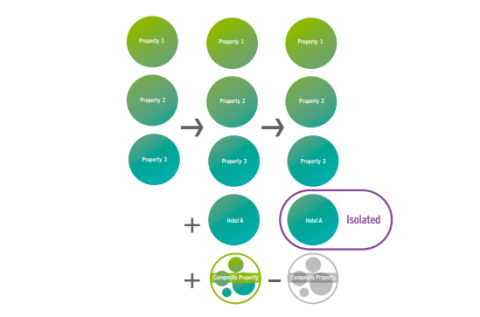
Potential Isolation Example #1
The following scenario would not be allowed per Competitive Set guidelines:
A Composite Property cannot be added in conjunction with the addition of another named hotel and then removed by itself.
- Add Named "Hotel A" and a Composite Property to a Competitive Set
- Drop the Composite Property
- Named "Hotel A" data is now isolated
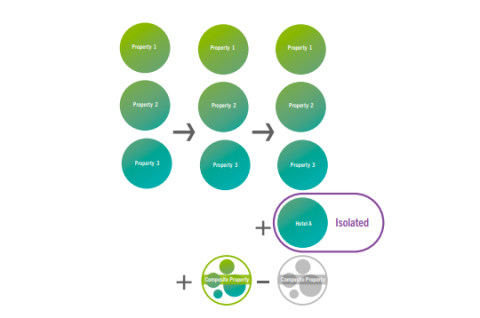
Potential Isolation Example #2
The following scenario would not be allowed per Competitive Set guidelines:
A Composite Property cannot be added by itself and then removed in conjunction with the addition of another named hotel.
- Add a Composite Property to a Comp Set
- Drop the Composite Property and adds Named "Hotel A"
- Named "Hotel A" data is now isolated
Discover how CoStar could help your business.
Contact us at 888-226-7404 or submit this form to request a demo.