
Some of the nation's biggest banks say that commercial real estate borrowers are withstanding higher inflation, a decline in consumer sentiment and economic uncertainty from the Iran war by not falling further behind on delinquent loan payments.
Under the watchful eyes of global economists, Wells Fargo, PNC Financial Services Group and First Horizon all reported on Wednesday stable levels of delinquent commercial real estate loans for the first three months of 2026, but said inflation could become an issue. Bank of America, the second-largest U.S. bank, reported significant improvement in the category in its first-quarter results.
The results are important because commercial real estate loans are one of the largest sources of business for banks, according to federal regulatory data, and the quality of loans that banks hold on their books is closely monitored for signs of stress.
After years of purging defaulted or delinquent loans — many tied to office buildings — banks appear to be on steady ground at a time of economic uncertainty and inflation spiking in March. Banks in 2025 started making more commercial real estate loans after a long pause, according to the latest Federal Deposit Insurance Corp. data.
The trend appears to be so far continuing at a modest pace, according to bank executives during quarterly earnings calls.
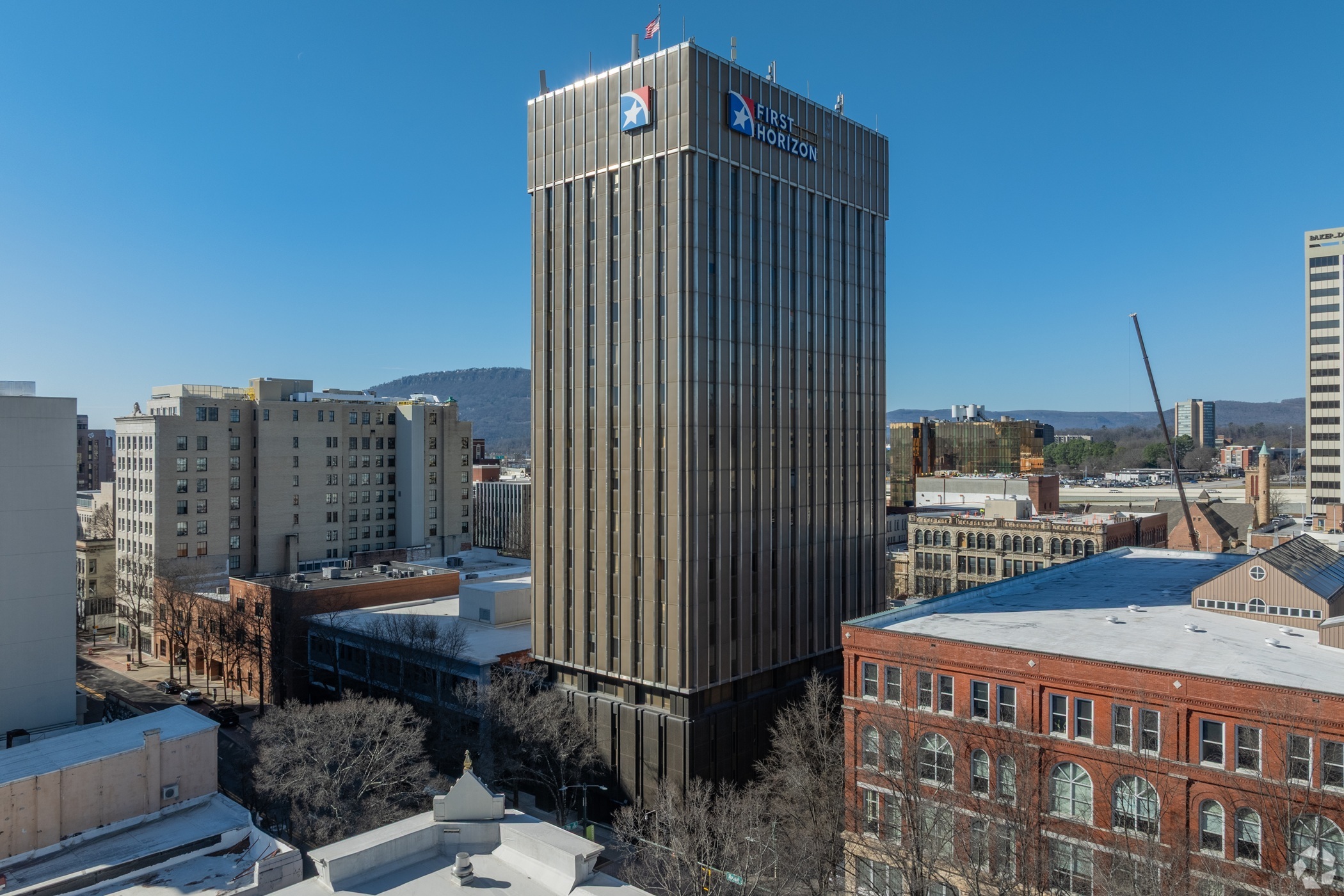
First Horizon's commercial real estate “pipelines are strong and present notable opportunities to stabilize … balances in the future,” Hope Dmuchowski, chief financial officer at First Horizon, said during a conference call on Wednesday.
The relative confidence projected by leaders from the banking sector contrasts with negative indicators from the broader economy. The U.S. and Israeli military offensive against Iran led to higher gasoline and diesel prices in March, pushing the annual inflation rate to 3.3% from 2.4% in February, according to CoStar economist Christine Cooper and senior director of market analytics Chuck McShane.
Consumer sentiment fell 6% in March, hitting its lowest level since May 2025, according to the University of Michigan’s monthly index. Even so, the S&P 500 and Nasdaq stock indices closed at record highs on Wednesday.
Cautious optimism
Bankers expressed a sense of cautious optimism based on first-quarter earnings figures, at least when it comes to commercial mortgage lending.
Bank of America’s nonperforming commercial real estate loans dropped 44% to $1.19 billion in the first quarter compared with the same period a year earlier. “Nonperforming loans” refer to loans where the borrower is at least 90 days late on scheduled payments.

Other banks said holdings of nonperforming commercial real estate loans either improved slightly or were little changed in a year-over-year comparison. At Wells Fargo, the category declined 2.6% to $3.78 billion. PNC, based in Pittsburgh, said they fell 26% to $630 million. And over at First Horizon, a regional bank based in Memphis, Tennessee, loans of that type rose 1.7% to $243 million.
“Our credit quality is still really strong,” Wells Fargo CEO Charlie Scharf said in a Tuesday conference call.
Not all large banks provide detailed information on credit-quality metrics for commercial real estate. JPMorgan Chase, the largest bank in the U.S., does not disclose delinquency rates for its $146.8 billion book of commercial real estate loans. Morgan Stanley lumps residential and commercial real estate loans together in one category.
But details that banks like Wells Fargo share shed light on an improved part of the industry. Wells Fargo, based in San Francisco, said it charged off $19 million of commercial real estate loans in the first quarter, down from $158 million in the fourth quarter of 2025. In a charge-off, banks concede that a borrower will never repay a loan, and it is reported as a total loss.
“It’s likely energy prices will have some impact on the economy, but we feel good about where our customers and our company stand today,” said Scharf, signaling that the bank is closely tracking effects on borrowers.

Macroeconomic concerns are still present, however, and Bank of America made an unexpected move — reducing some reserves — in light of those concerns, Saul Martinez, an analyst at HSBC, told executives during a Wednesday conference call. He said he did not expect to see Bank of America decrease its reserves for potential defaults for all types of loans.
“I was a little bit surprised that you saw the slight reserve release, given the macro uncertainties,” Martinez said. “It does seem like you take a different approach to reserving than some of your peers. Why not be a little more conservative in your reserving?"
Reserves for unpaid loans
Bank of America, based in Charlotte, North Carolina, released $72 million from reserves in the first quarter, compared with an increase of $28 million in the first quarter of 2025. The bank also cut its provision for credit losses 9.7% to $1.34 billion in the first quarter compared with the same period a year earlier.
Bank of America’s stance is counter to how most large banks view reserves, according to a recent survey of industry analysts complied by Brean Capital, a New York-based investment bank. About two-thirds of equity analysts that cover the banking sector expect the largest banks to add to reserves that can be used to cover unpaid loans.
Top leaders at Bank of America said they don’t believe they need to increase reserves because they’re picky about their customers and the types of loans they make.
“We just think we’ve got a higher-quality client base and a higher-quality loan portfolio,” Chief Financial Officer Alastair Borthwick said during the call in response to Martinez.
First Horizon reported a minor amount of worsening for its commercial real estate loans, with charge-offs rising to $3 million in the first quarter from $2 million in the previous quarter.
Citizens Financial Group, KeyCorp and U.S. Bancorp are scheduled to report first-quarter earnings on Thursday. Fifth Third Bancorp, Regions Financial and Truist Financial are set to report on Friday. Thousands of community banks will file call reports with regulators in the coming weeks about their financial results.