
Electric vehicle maker Rivian and retail developer Caruso have struck a partnership that underscores how electric‑vehicle infrastructure is increasingly being treated like a retail tenant.
Rivian and Caruso have signed a multiyear agreement to install more than 150 public chargers across Caruso’s Southern California properties and open two new showrooms at Los Angeles–area centers beginning this year.
The new showrooms, planned for The Commons at Calabasas and The Americana at Brand in Glendale, are set to be gallery‑style spaces featuring events and private experiences. Rivian already operates showrooms at Caruso’s The Grove in Los Angeles, as well as locations in Pasadena, El Segundo and Venice Beach.
In addition to charging infrastructure, the deal includes ride‑and‑drive events that allow shoppers to test new models, along with vehicle displays and marketing tied to Caruso’s experiential retail model. Rivian owners enrolled in Caruso’s membership program will also receive free parking across the portfolio.
“This partnership allows Rivian to meet our customers where they already are,” Marc Navarro, senior manager of real estate at Rivian, told CoStar News. He described the strategy as embedding retail, charging and entertainment in a way that feels seamless to visitors while boosting overall property performance.
The deal is the latest partnership between automakers and retail landlords. In 2025, Federal Realty Investment Trust partnered with Mercedes‑Benz to roll out fast chargers across roughly 50 shopping centers nationwide. Simon Property Group has also teamed up with Mercedes to bring charging to its mall portfolio.
Like those arrangements, Rivian’s agreement reflects how EV infrastructure is becoming more integrated into retail portfolios. But the Caruso partnership goes beyond charging alone, tying showrooms, test drives and on‑site programming more directly into the shopping experience.

EV expansion
The timing coincides with continued EV adoption in Southern California, where dense population, environmental policy and high fuel costs are pushing more consumers toward electric vehicles.
Los Angeles County now has roughly 588,000 electric vehicles on the road — one of the highest concentrations in the country — reshaping how charging infrastructure is planned.
Sales are slipping; Californians purchased about 63,000 new electric vehicles in the first quarter of 2026, down roughly 37% from a year earlier, when the federal government offered rebates on EV sales, according to data compiled by Veloz from the California Energy Commission. Still, developers are ramping up charging networks to boost adoption and meet demand.
Los Angeles has thousands of public EV charging locations, with nearly 10,000 public charging ports citywide, including several hundred fast chargers.
Even so, “charging deserts” persist in parts of the region where EV ownership is high but public access remains limited, prompting landlords and retail owners to step in and rethink how charging fits into the tenant mix and customer experience.
Upscale retail exposure
Caruso’s properties have long leaned into experience — from choreographed fountains to seasonal events — to drive repeat visits and tenant sales. The company owns roughly 50 properties totaling about 2.3 million square feet across Southern California, almost all retail, with a small number of luxury multifamily complexes adjacent to its centers, according to CoStar data.
The Rivian partnership aims to apply that same experiential playbook to EVs, treating charging time as an opportunity to keep customers on site longer.
“This isn’t about adding a single use, but about seamlessly blending retail and experience,” Jackie Levy, Caruso’s chief financial and revenue officer, told CoStar News.
He said the strategy is designed to enhance how visitors spend time at properties while positioning them for long‑term relevance.
Chargers will be placed in high‑visibility, high‑traffic areas rather than tucked away, reinforcing their role as part of the guest journey. Over time, Caruso aims to make EV charging as expected as parking or Wi‑Fi.
The partnership also includes sponsorship of marquee events such as The Grove’s Christmas tree lighting, tying Rivian’s brand to moments that draw regional crowds. That alignment turns retail centers into ongoing marketing platforms rather than one‑off sales channels, Levy said.
Rivian's road to growth
Rivian operates about 125 customer‑facing locations globally, including roughly three dozen gallery‑style “Rivian Spaces” and more than 50 larger service hubs that combine sales, demo drives and vehicle servicing. California accounts for 32 of those locations.
While still a smaller automaker — delivering about 10,000 vehicles in the first quarter of 2026, versus more than 350,000 at Tesla and well over 400,000 at Ford and General Motors — Rivian is expanding as it pushes toward more affordable models and broader scale.
The Los Angeles‑based company recently leased a 49,470‑square‑foot light manufacturing building in the Inland Empire from Dedeaux Properties to serve as a sales, service, charging and repair hub.
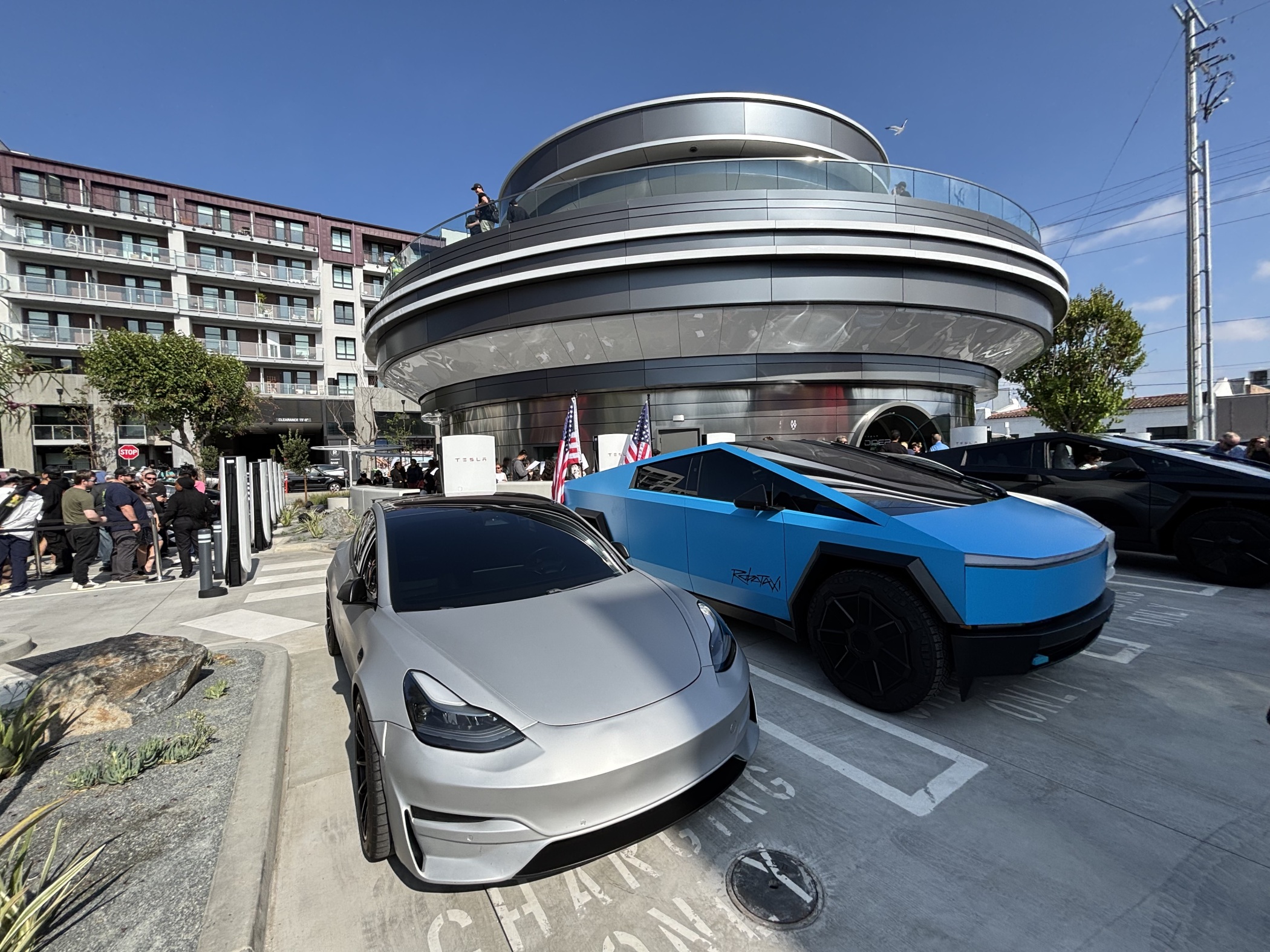

Its retail strategy increasingly centers on infill locations where customers already live, shop and spend time. By placing chargers at dense retail centers, Rivian captures routine trips — coffee runs, grocery visits and movie nights — increasing usage frequency while reinforcing brand familiarity.
“The model allows us to unify charging, retail, tech and community into one cohesive experience,” Rivian's Navarro said.