Editor’s note: In recent months, STR has reported on Airbnb’s impact on the hotel industry, including a series of articles in February that provided an inside look at Airbnb’s impact on New York hotels based on data provided directly by Airbnb. STR was not remunerated in any way for its analysis, and its participation in the analysis was not contingent upon developing or reporting predetermined results.
The following analysis of Airbnb’s impact on the hotel industry in Sydney is based on data provided by InsideAirbnb.com, which compiles data by scraping listing information from Airbnb’s website. STR has not independently verified the data from InsideAirbnb.com.
This analysis does not attempt to propose a position of Airbnb’s legitimacy within the marketplace, but rather to provide commentary based on publicly available information about Airbnb’s current supply and pricing compared with traditional operators.
LONDON—InsideAirbnb.com has continued to harvest Airbnb listings and has detailed maps that show the locations and requested rates of units in the Sydney area. STR, the parent company of Hotel News Now, has used this data to gain a better understanding of the potential implications of this new inventory on the hotel marketplace.
The data set used here only utilizes unit listings and requested rate. There is no way to accurately determine rooms booked and realized rate from scraped data, so this article refrains from making estimates. It is fair to assume, however, that the requested rate is fairly close to the achieved rate (what we normally refer to as average daily rate) because the room rate is not subject to impacts of corporate, government or loyalty discounts. That is not to say that these discounts will not be available.
The data is available only for specific points in time, and because owners can easily add or remove listings, the actual monthly supply of Airbnb units fluctuates. That said, a percentage of the total Airbnb inventory is from rental companies that offer multiple listings, so it is likely that they show their rooms online only when they are available. Based on this, we assert that the inventory is, if not a perfect representation, at least “directionally indicative” of supply competition and prevailing rates. For this article, STR used the hotel performance data for the 12-month period ending 31 December 2015 based on Airbnb data gathered on 3 January 2016.
The inventory was separated into local government areas, or LGAs, using the statistical postal codes of the Australian Bureau of Statistics. There might be some slight statistical movement in the results with not all postal codes being exclusive to an LGA. Not all Airbnb inventory is of the same type. The analysis separates what is most likely “comparable.”
Airbnb “comparable” units excluded tree houses, boats and the like. Units also had to offer a real bed (not a couch or air mattress). Shared rooms and private rooms also were excluded, so the analysis focuses on entire homes/apartments with fewer than four bedrooms. We also attempted to remove inactive listings from our analysis. Listings were only counted if they were available at least five days over the next three months and had received a user review in 2015. The host response rate also had to be greater than 50% with the calendar updated within the past six months.
Inventory impact
As of 3 January 2016, a total of 16,149 available Airbnb units were reported in Sydney, according to InsideAirbnb.com. The listing types are below:
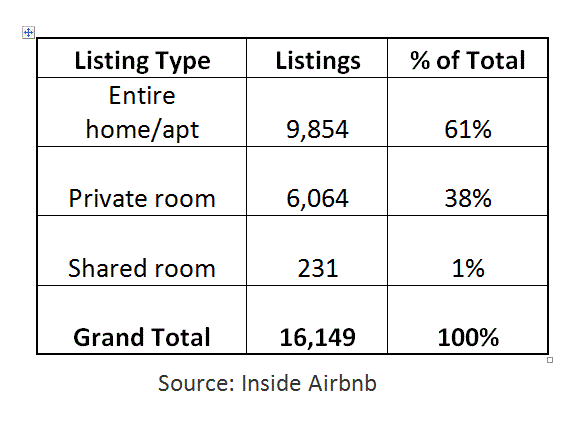
The combined number of accommodation units between Airbnb listings and hotel rooms is 55,400 available supply units (29% Airbnb and 71% hotel accommodation). Since Airbnb was originally envisioned as a sharing platform, it is clear by the listing types that the majority of Airbnb options are now entire homes or apartments.
To understand the implications of inventory on Sydney’s accommodation market, a series of criteria were used to find a preferred measure of “comparable.”
Of the listed Airbnb properties, 5,385 were deemed competitive, accounting for 33% of total listings. The four highest concentrations of units were in the city of Sydney, Waverley, Randwick and Manly LGAs, which also have the highest concentration of hotel rooms. But two of the four—the city of Sydney and Waverley—contributed a combined 49% of all available Airbnb units.
In absolute terms, there is a distinct difference between these two LGAs and the rest with no others contributing more than 400 listings. The largest market for Airbnb units is the LGA of the city of Sydney, with 1,485, or 28% of total Airbnb units. Although the largest LGA for Airbnb listings, the city of Sydney comprises a 6% total share with more than 23,000 traditional hotel rooms available on a nightly basis.
Waverley, Randwick and Manly had the highest share of total rooms available in each LGA. Waverly contributed 55% of all rooms within the LGA, or 1,130 units. That is more than the total of available hotel rooms in this market. The Waverley LGA is famous for its beaches, including Australia’s most famous beach, Bondi.
Although still small in quantities, there are some more remote LGAs where Airbnb is the sole provider of accommodation to the geographic area. But it is worth noting that Airbnb’s contribution in 15 of 38 LGAs is less than a 10% share of total supply.

Pricing comparison
Of the 38 LGAs, 10 have sufficient data that allows us to protect the confidentiality of individual hotels and to compare their hotel average daily rates to the Airbnb averages. The difference in rate was 1 Australian dollar ($0.75) in favor of hotels, but there were large variances in each of the LGAs.
Five of the LGAs have higher average rates than hotels, which is not surprising considering they are renting out entire homes or apartments rather than single hotel rooms. The four LGAs with lower averages than hotels are in western Sydney, and this could indicate demand location behavior of Airbnb customers, as pricing opportunities for Airbnb vendors are affected by constrained demand in the center of the city.

Pittwater and Waverley had the highest average for Airbnb units at AU$309 ($233.18) and AU$278 ($209.78), respectively, which potentially illustrates the value of proximity to the beach.
Competition by price point
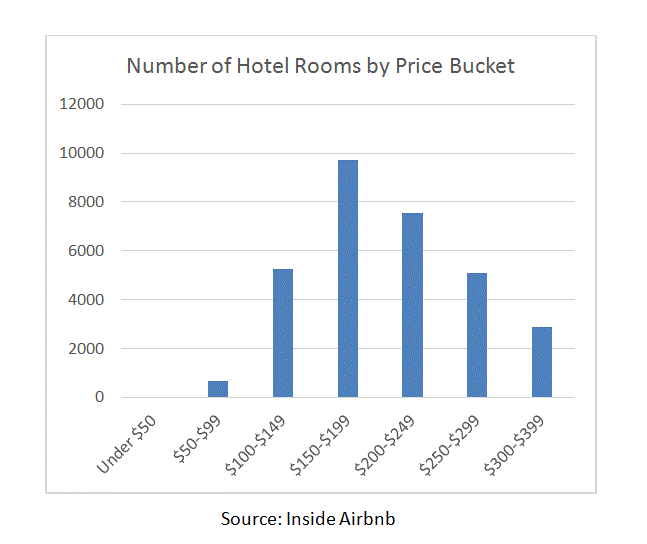
The distribution of prices by bucket of the “comparable” listings is fairly similar, with 50% of hotel accommodation units below AU$200 ($150.92) and 54% for Airbnb.
By spread, two clear points can be extracted. Airbnb units at either end of the bell curve represent a greater percentage of total contributions, and hotel accommodations have a recognizably greater share, between AU$150 ($113.19) and AU$249 ($187.89). Airbnb has 100% of rooms at AU$50 ($37.73) or under and 57% share of listings above AU$400 ($301.79). Conversely, between the AU$150 and AU$299 ($113.17 and $225.58) range, hotel rooms take 90% share of rooms.
The highest Airbnb distribution of 28% is within the AU$100 to AU$149 ($75.44 to $112.41) bucket, while for hotel accommodations 31% of distribution is between AU$150 and AU$199 ($113.17 and $150.12).

Conclusions
Although this analysis applies a number of filters to determine “comparable” rooms, it is clear that although 16,149 Airbnb listings exist, fewer than a third are real “potential competitors.”
Provided that the Sydney hotel market finished 2015 at 85.2% absolute occupancy (and on many available forecasts occupancy is anticipated to rise further), Airbnb’s position as an alternative to hotels could strengthen. Hoteliers, with such occupancies, are focused on rate growth, which might cause consumer price ceilings to bring Airbnb forward as an option for consumers.
Without an understanding of actual demand behavior for Airbnb listings, it is difficult to say whether this is having any positive impact thus far to Airbnb hosts’ demand and/or their decision making in raising their average rates in line with hotelier behavior. To date, hoteliers continue to see their occupancies grow. But that growth is slowing with a majority occurring outside the central business district. When the CBD submarket has just shy of 50% of days above 90% occupancy, on busy nights customers will either elect to stay away, fly in and out, stay farther out or consider other accommodation options.
With further segmentation analysis of corporate (business) and leisure travelers, both domestic and international, it would reveal a greater understanding as to how consumers behave and influence demand. This in turn would shape knowledge of how current and future demand is split and support future pricing decisions.
Outside the city of Sydney LGA, where hotel accommodation is not as prominent, Airbnb has grown a presence. This might be a case of realizing untapped demand or a nature of residential stock utilizing an investment in a particular manner. Our international experience says that in general, Airbnb units are more prominent as a percentage in suburban locations.
With the recent openings of hotel accommodations in the Waverley LGA, it might be a case of hotel accommodation tapping into a desired location. The location of hotel and Airbnb listings also might speak to the traditional nature of travel, be it for work or leisure. As consumers become more intrigued by living like a local in the suburbs with sufficient amenities, Airbnb rentals could become a more desired source of location for both leisure and business travelers.