
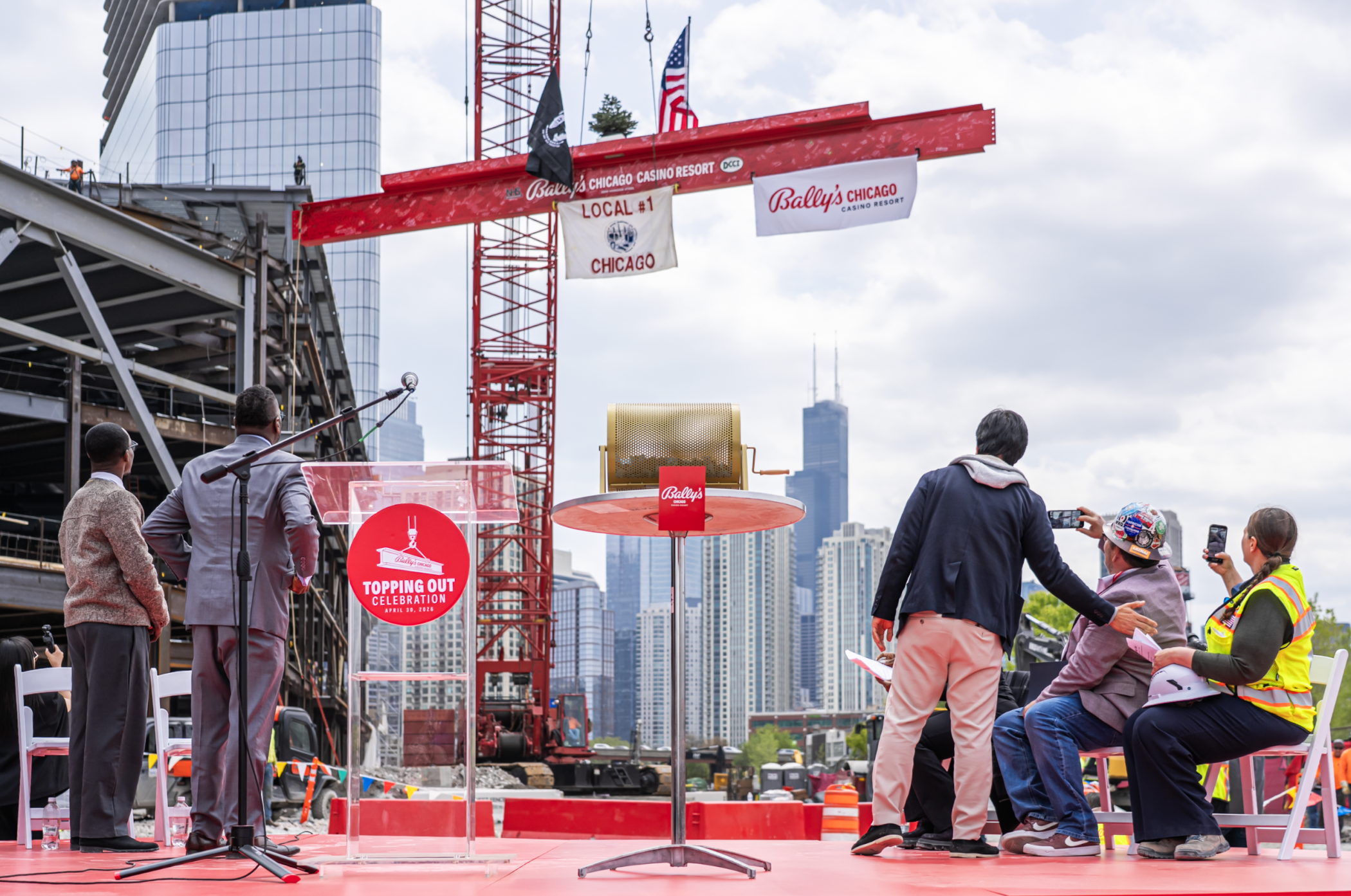
Chicago’s decades-in-the-making push to open a casino in the city has moved a step closer to reality, with the transformative Bally's project reaching its full architectural height along the Chicago River.
The skeleton of the $1.7 billion, 34-story hotel at 777 W. Chicago Ave. now towers over the river that runs through the nation’s third-largest city.
Beyond Chicago, the project is expected to draw close scrutiny from U.S. real estate, gaming and land‑use professionals eager to see how casino‑anchored developments perform in major urban markets, particularly as similar projects take shape elsewhere.
The milestone comes the same week that a permanent casino opened in New York’s Queens borough — the first of three planned in the country’s largest commercial real estate market.


The Chicago project on the 30-acre former Freedom Center newspaper printing site will include the 500-room Bally’s hotel, a 3,000-seat theater, a 2-acre park, restaurants, cafes and a food hall.
The River West casino complex — one of the biggest ongoing construction projects in the city, employing more than 1,000 union laborers — is expected to open in the first quarter of next year.
Bally’s Chairman Soo Kim acknowledges “fits and starts” in the long-awaited project and noted its importance at a time of relatively muted construction in Chicago.
“It’s a big deal,” Kim said in an interview with local media after a ceremony to mark the placing of the highest beam. “This is the third-largest metropolis. There’s gaming all around it, but there’s not gaming here.”
Years after site selection
The event came almost exactly four years after then-Mayor Lori Lightfoot chose the River West site over two other finalists.
It was a notable moment after several previous mayors unsuccessfully pursued plans to put a tax-generating casino in the city after the arrival of gaming in suburbs, throughout Illinois and in neighboring states.
Lightfoot, current Mayor Brandon Johnson and other politicians attended Thursday’s ceremony.

Resorts World New York City opened this week as that city’s first full-scale commercial casino, with two other casino projects — including a $4 billion Bally’s project in the Bronx — expected to open there around 2030.
“New York, I don’t know if it was in response, but it also has mandated three casinos in that city as well,” Kim said after the ceremony. “We’ll have ours open in three years and change.”
The broader trend of major cities adding casinos is an effort for the largest population centers to capture more tax revenue, he said.


“I think it’s really as simple as, why should Chicagoans, jobs and tax dollars leave and go 25 miles away to a different state?” Kim said of nearby Indiana. “Why should the neighboring towns get all the jobs and money? The average American lives less than a half-hour from a casino. That’s just how it is. There’s legalized gaming in over 40 states. I just think that everyone is going to want their own version to meet their own community needs.”
Initial revenue questions
As Bally’s plan was introduced in Chicago, critics questioned whether it would generate as much tax revenue as it claimed and wondered whether Providence, Rhode Island-based Bally’s heavy debt burden would hinder the project.
The other finalist proposals were for Rush Street gaming to put a casino within Related Midwest’s riverfront project in the South Loop called The 78 — since chosen by Major League Soccer’s Chicago Fire for a new stadium — and a plan by Hard Rock to team up on Wisconsin developer Bob Dunn’s One Central mixed-use plan for a platform that would be built over train tracks near Soldier Field.

The Bally’s plan was approved by the Chicago Plan Commission and then the City Council in December 2022, followed by final approval from the Illinois Gaming Board.
Johnson touted the potential for more than $100 million in new annual tax revenue from the casino, which he said will help pass future budgets.
“The revenue will support our police and fire pensions and our ongoing efforts to build a more equitable, safe and affordable Chicago where every community has the opportunity to thrive,” Johnson said during the ceremony.
Bally’s bought the site, the Chicago Tribune’s former Freedom Center printing plant on 30 acres, for $200 million in late 2022. Bally’s then assigned the purchase to Oak Street Real Estate Capital as part of that firm’s planned $500 million financing for the project’s construction.
As part of that sale-leaseback deal, Bally’s signed a 99-year ground lease with two options for 20-year renewals.
Plans for the site had to be redrawn in 2024 because of worries that the location of the hotel could damage underground water pipes running through the site.
Construction was switched from multiple planned phases to one larger phase, with Gaming and Leisure Properties stepping in to provide a $940 million financing package. The hotel was moved to the south end of the site.
Gradual deal progression
The new deal came with an initial 15-year lease to Bally’s, with the casino company agreeing to pay $20 million annually with scheduled rent escalations, according to Securities and Exchange Commission filings.
Gaming and Leisure Properties paid $250 million for the site, or $50 million more than Oak Street paid.
Demolition of the printing facility began in 2024, followed by construction.
The sprawling site runs along the river between Chicago and Grand avenues north of the Loop business district.

The HKS-designed project will create a 2,000-foot-long extension of the city’s Riverwalk.
During construction, Bally’s has been operating a temporary casino out of the historic Medinah Temple building at 600 N. Wabash Ave. in River North. The Moorish Revival building is owned by Chicago-based Friedman Properties.
Kim said the permanent casino complex aims to be a destination for tourists as Chicago’s massive McCormick Place competes for the nation’s largest conventions.
“I think the real potential is, Chicago for a long time was the convention city,” Kim said. “Now there’s competition for conventions from Orlando, New Orleans and Vegas. Chicago’s still a great convention city. There’s 75,000 rooms here. After 11 o’clock there’s not that much to do. It’s not a 24-hour town. We’ll be running entertainment, food and beverage 24 hours.
“It presents the city in a different way. It’s actually a 24/7 option that the city did not have before.”