
Note: “Match days” throughout this article refers to both the night before and the night of the match, which are the peak nights for hotel performance around the World Cup matches. “Shoulder days” refers to all other nights.
The U.S. hotel industry reached all-time highs in both revenue per available room (RevPAR) and average daily rate (ADR) in the week of June 21-27.
Last week’s nominal RevPAR of $129 and nominal ADR of $178.82 were the highest weekly totals for any week on record in the U.S. RevPAR increased 9.6% year over year, marking the 12th consecutive week of growth, while ADR rose 9.2% for its 17th straight week of year-over-year gains. Occupancy also reached a 2026 weekly high of 72.2%, although the 0.3-percentage-point increase was lackluster in comparison.
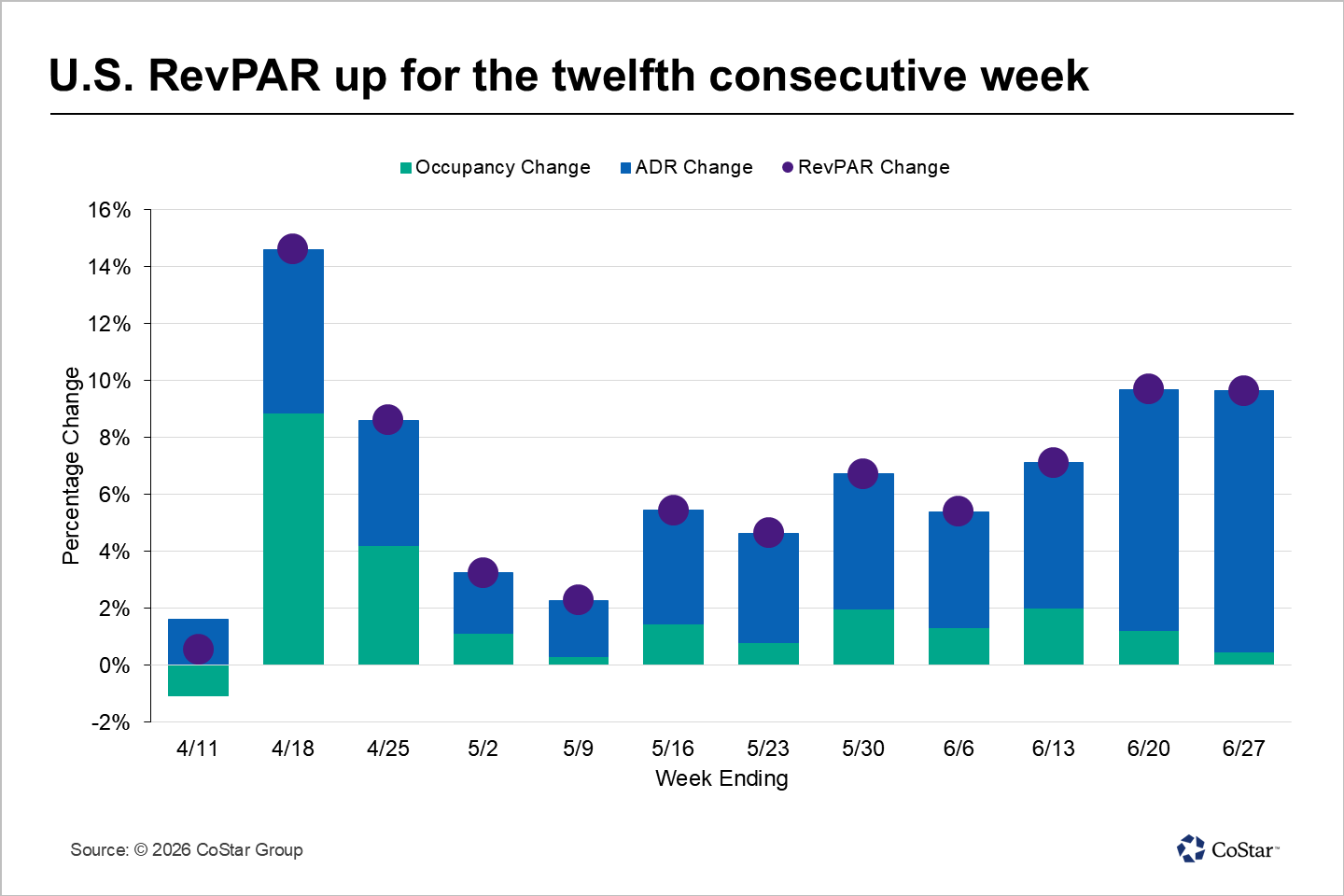
While the 2026 FIFA World Cup continues to help push U.S. hotel performance to record levels, the tournament's influence remains uneven. Host markets are producing extraordinary ADR increases, but many business and leisure travelers appear to be shifting trips outside the tournament footprint. As a result, the strongest hotel demand growth is increasingly occurring in markets not hosting matches.
World Cup
World Cup host markets in the U.S. posted a 16.7% increase in RevPAR during the final week of the group stage despite a 2.9% decline in hotel demand. ADR surged 21%, while occupancy fell 2.8 percentage points year over year. Last week represented the most concentrated portion of the tournament to date, with 27 matches played across the United States from Sunday through Saturday, yet host-market occupancy and demand continued to trend below last year's levels.
Last week's U.S. hotel performance reinforced trends that have been evident since the start of the tournament. Since the start of the games, match days have seen a RevPAR gain of 25.8%, with ADR increasing 25.9% and occupancy remaining essentially flat. Performance outside of match nights has been markedly different. Shoulder days have produced a 9% RevPAR increase on a 13.7% ADR gain, but occupancy has declined 3.1 percentage points. Every host market except San Francisco has declined in occupancy on shoulder days.
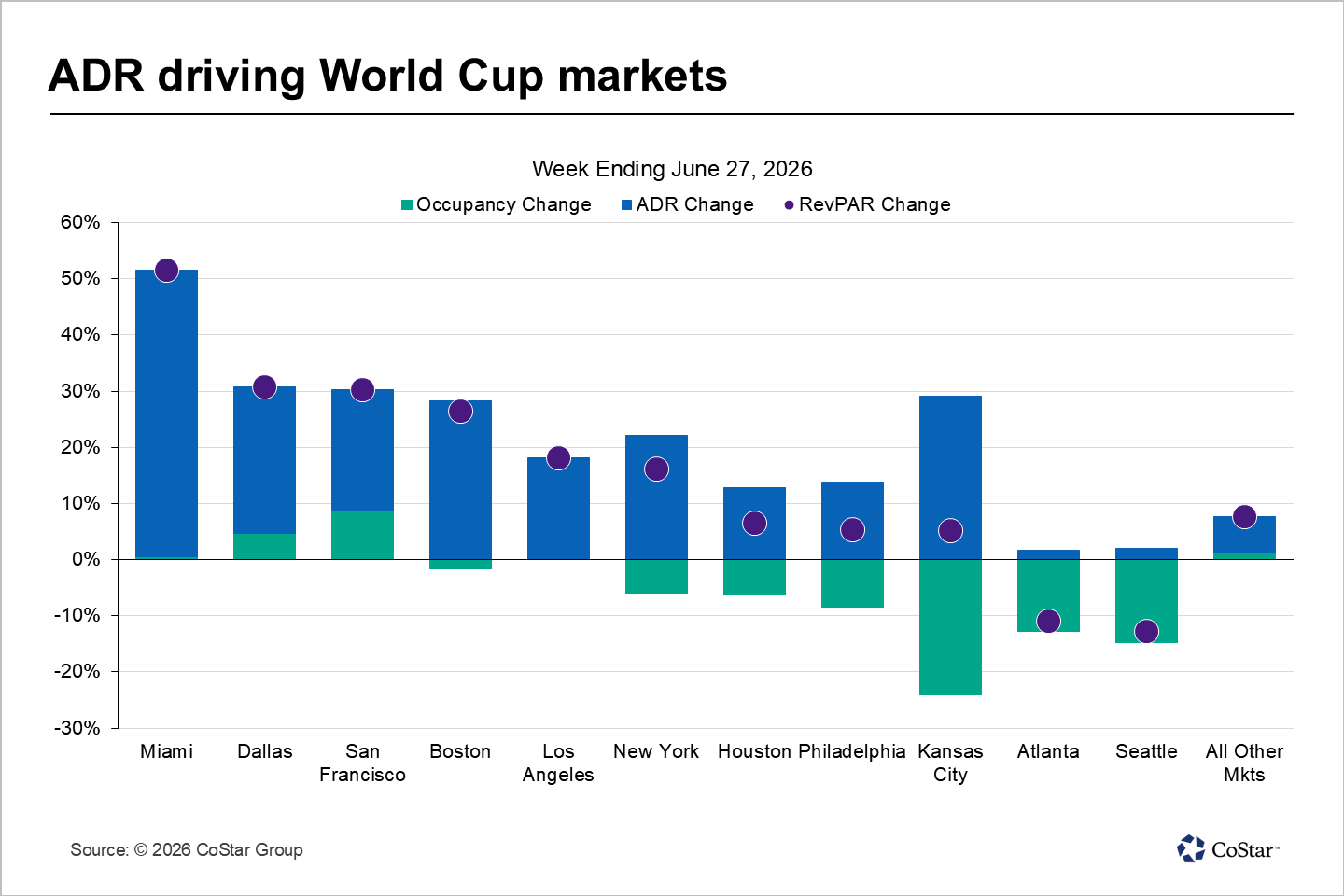
Miami exemplified the trend last week. The market led all major U.S. hotel markets with a 51.6% RevPAR increase despite occupancy increasing only 0.3 percentage points. ADR was up 51.1%, supported by five consecutive days of ADR growth exceeding 50%, spanning from the Brazil-Scotland match on Wednesday through the Colombia-Portugal match on Saturday.
From June 11-27, host market RevPAR (all days) is up 18.7% versus 7.9% for non-host markets. Combined U.S. RevPAR during this period is up 10.3%.
Non-host markets
While attention remains focused on World Cup host cities, hotel performance across the rest of the U.S. continues to show broad-based strength. Non-host markets combined for a 7.6% increase in RevPAR last week, extending a three-week streak of RevPAR growth above 6% since the start of the tournament. ADR remained the primary growth driver, increasing 6.2%, but unlike host markets, hotel demand also expanded, rising 1.7% year over year.
Among non-host markets are 15 top 25 U.S. hotel markets. Those 15 markets continued to lead performance gains with a combined RevPAR increase of 12.9%, not far behind the growth achieved by World Cup host markets. ADR increased 10.6%, below the pace of host cities, but a 2.3% gain in demand contributed to a 1.6 percentage point increase in occupancy.
Demand displacement
Since the start of the World Cup, host markets have continued to see year-over-year declines in rooms sold. While host cities have benefited from substantial ADR growth, many business and non-World Cup leisure travelers appear to be choosing alternative destinations. Since June 11, hotel demand in tournament host markets is down 1.1%, while demand across the rest of the country is up 2.3%. Non-host top 25 markets have experienced the largest increase, with demand rising 3.3%.
Group demand clearly illustrates the shift. Luxury and upper-upscale hotels in host markets saw group demand fall 20.5% last week, while comparable properties in non-host Top 25 markets recorded a 9% increase. These major non-host markets are likely benefiting from business travel that may otherwise have occurred in tournament cities.
The lowest-performing host markets last week further highlighted this trend. Despite hosting a combined seven World Cup matches, Atlanta, Seattle and Kansas City experienced a combined 13.5% decline in hotel demand and an 11.2-percentage-point drop in occupancy. Each of these markets hosted major business conferences during the same week last year that either moved to different dates or different cities. The absence of those events more than offset any incremental room demand generated by World Cup matches.
The substitution effect was not limited to business travel. Weekend hotel demand data suggest leisure travelers are also increasingly choosing destinations outside the tournament footprint. On Friday and Saturday last week, host markets recorded a 3.2% decline in demand, while non-host markets saw weekend demand increase 3.9%. The trend was even more pronounced among major metropolitan markets, as non-host Top 25 markets experienced a 5.5% increase in weekend hotel rooms sold.
Class performance
The strongest gains continued to occur at the upper end of the U.S. hotel market. Luxury and upper-upscale hotels combined for a 13.2% increase in RevPAR nationally last week, outperforming the overall U.S. industry. These classes also experienced the largest lift in World Cup markets, where RevPAR increased 21.1%.
Like host-market performance, growth at higher-end hotels was driven almost entirely by ADR. Luxury and upper-upscale properties in World Cup markets posted a 27.7% increase in ADR, while hotel occupancy declined four percentage points and demand fell 4.2% year over year.
Global RevPAR rebounds
After three weeks of flat to declining performance, global hotel RevPAR on a comparable and constant USD basis — excluding the U.S. — rose 2% as ADR rose 4.6% and occupancy declined 1.8 percentage points. The growth was widespread with only China, the Gulf Cooperation Council (GCC) and Latin America seeing decrease.
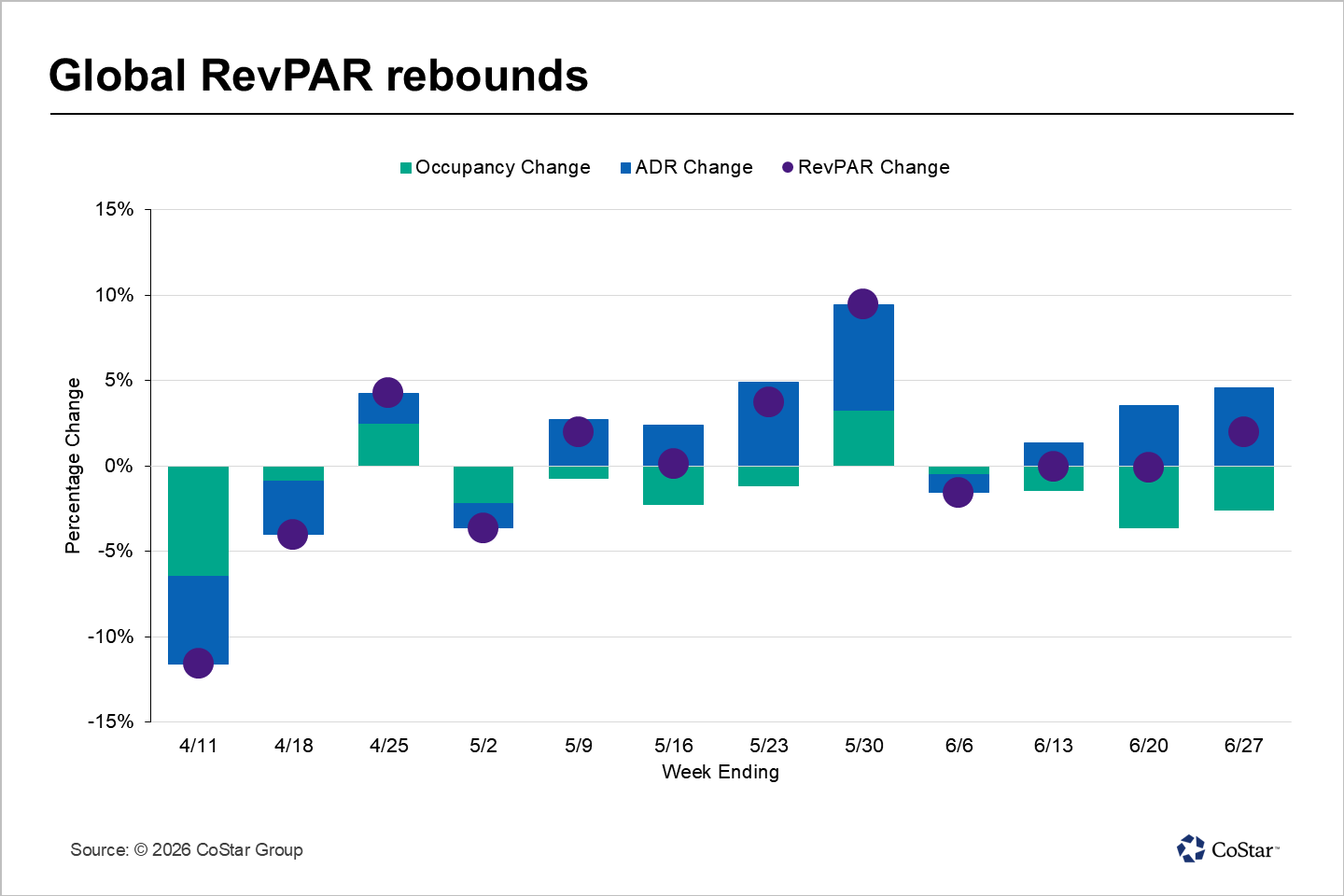
India continued to see the strongest growth of the key countries with RevPAR rising 24.9% in the week. Europe also saw solid RevPAR gains despite the record-breaking heat. France was up 9.8% this week followed by the U.K. (+6.8%). Germany, Italy and Spain all saw RevPAR advance by more than 3%. Like the U.S., ADR was generally the primary driver across the globe.
RevPAR in Canada rose 1.4% on the back of the two World Cup markets as all other markets were down collectively. Toronto’s RevPAR increased by 12.4% whereas Vancouver’s was up 5.1%. Both markets saw ADR rise by more than 26% with decreasing occupancy.
Mexico’s RevPAR declined 3.8% with all the key tourist markets down significantly in occupancy. The measure fell by more than 15 percentage points in Cancun and the Mexican Caribbean, resulting in RevPAR decreases of more than 25%. The country’s RevPAR decline was mitigated by the three World Cup Markets (Guadalajara, Mexico City and Monterrey) where RevPAR rose by 47.5% on a 60.6% ADR lift. Since the start of the games, World Cup markets have seen RevPAR rise by 43.3% versus a 14.8% decline everywhere else.
Cole Martin is Analytics and Insights Specialist at STR and Isaac Collazo is senior director of analytics at STR.