The U.S. Department of Homeland Security bought at least 10 large-scale vacant warehouses in seven states from sellers including Goldman Sachs and Carlyle Group — while other owners pulled out of deals after public backlash — as part of the federal government's plans to reform its national network of detention centers.
As of Feb. 26, Homeland Security's U.S. Immigration and Customs Enforcement has bought industrial space totaling more than 6.8 million square feet in the past two months for at least $894 million, often paying a premium for the real estate in the once white-hot U.S. industrial market that is now dealing with a downturn in demand.
In a CoStar market analysis of deals that have closed, ICE appears to be paying an 11% to 13% premium, with some properties trading at over 30% of recent comparable trades in the market. The pricing premium comes at a time when CoStar is clocking the highest level of completely vacant for-sale large logistics property listings above 200,000 square feet on the market in the United States.
ICE is transforming how it detains and processes immigrants as part of what it is calling the ICE Detention Reengineering Initiative. The plan includes expanding bed capacity and hiring more officers while reducing its detention network from hundreds of facilities to just 34. ICE plans to increase its detention capacity from more than 70,000 beds to 92,600 beds by the end of November and spend a total of $38.3 billion as part of the initiative, according to government records.
ICE has been acquiring large, vacant warehouses from private companies as part of the initiative as it makes "arrests in states across the U.S. and is actively working to expand detention space," an ICE spokesperson told CoStar News in an email.

The 10 deals that have closed so far are less than half the 24 large-scale properties ICE wants to buy and renovate — eight for use as detention centers and 16 for regional processing sites — using funds from the One Big Beautiful Bill Act. In the past, ICE typically used facilities built specifically to support the agency's needs, according to the government. ICE also plans to buy 10 detention centers it already operates.
ICE's property expansion has raised concerns among lawmakers from both parties. The agency's tactics have drawn criticism in Congress from Democrats, who have held up funding after ICE's role in the shooting deaths of two U.S. citizens in Minneapolis in January while proposals for ICE detention facilities have been scrapped in Mississippi, New Hampshire and Tennessee after Republican lawmakers intervened.
Other deals for ICE centers have been called off by the potential seller themselves, including a warehouse in North Texas owned by Majestic Realty and a half-million-square-foot industrial building in Ashland, Virginia, owned by the Canadian billionaire behind his namesake firm, Jim Pattison Developments.
Costly renovations
The sale price of the new detention centers is only one part of a two-pronged spending plan to transform the facilities to accommodate thousands of detainees. For example, in Surprise, Arizona, a two-year-old warehouse acquired by ICE for about $70 million will undergo a $150 million retrofit — more than double its sales price — to turn the distribution hub that's surrounded by single-family homes and businesses into a regional processing center housing an average daily population of 1,000 to 1,500 detainees, according to an economic analysis from ICE.

As the federal government is buying up warehouses that were mostly built with the intention to serve as hubs to ship consumer goods, such as furniture and appliances, some property owners see an opportunity as elevated vacancy rates hit the U.S. logistics market, leaving empty warehouses in its wake.
"If we had continued population growth and trade growth, these warehouses would probably be completely occupied by a normal [industrial] tenant," said Juan Arias, national director for U.S. industrial analytics with CoStar. "The use is shifting into what is a complete outlier from normal market conditions."
Continued uncertainty tied to the nation's trade policy even after the Supreme Court struck down President Donald Trump's tariffs is expected to continue to roil the industrial sector for the foreseeable future, Arias said, putting property owners in a difficult spot with pre-pandemic trends not expected to return until 2028.
"We are in this window where a warehouse could sit empty for another two years," Arias added.
The federal government's offer to pay above market values would likely be enticing to landlords, especially those that own the real estate as part of a fund where they have a fiduciary responsibility and expectation it will make money for investors. In simple terms, Arias said, the government isn't buying these properties the way normal real estate firms would acquire sites. The DHS has a large and growing budget and doesn't need to make a profit or answer to investors, he said, so it can afford to pay more than market price.

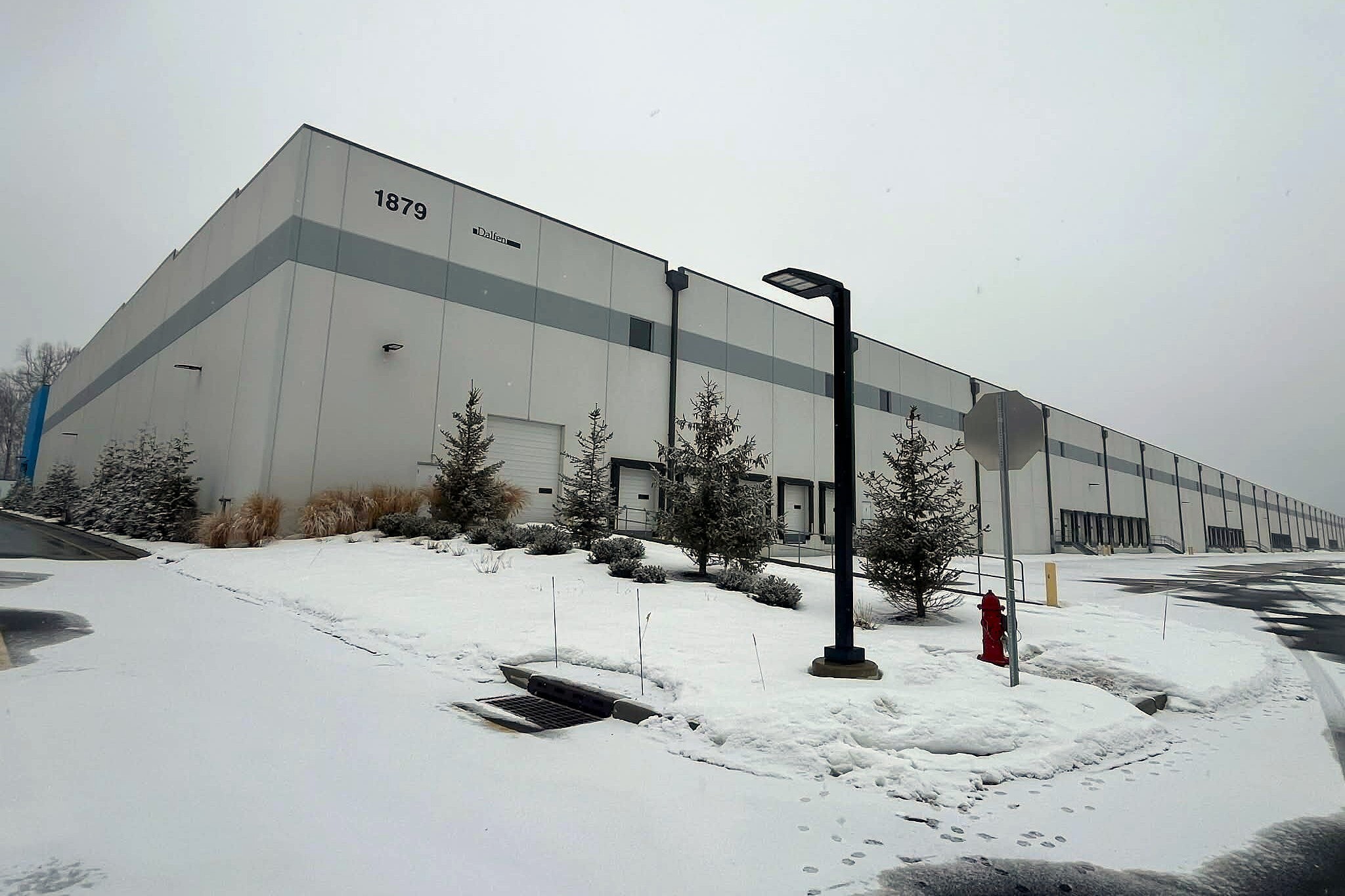
That's the case with Goldman Sachs, the former majority owner of a 470,000-square-foot vacant industrial warehouse bought by ICE in February for $129.3 million at 1879 Route 46 in Roxbury, New Jersey, a suburban area roughly 45 miles from New York City. The financial services firm had a fiduciary obligation to investors in a real estate investment fund to sell the property that has sat vacant for two years, a Goldman Sachs spokesperson said in an email to CoStar News.
The minority investor behind the New Jersey warehouse, Dallas-based Dalfen Industrial, said the partnership sold the property to the federal government in lieu of the potential of imminent domain with the firm having "no involvement" in the future use of the facility.

Other sellers — PCCP, Fundrise, Carlyle Group, PNK Group, Rockefeller Group, Oakmont Industrial Group, Flint Development, Blue Owl Capital and Crestlight Capital — did not respond to requests from CoStar News for a comment.
ICE didn't respond to questions about its real estate pricing strategy, but confirmed the 10 purchases and touted the jobs and tax revenue it expects to bring to each region.
Community impact
An ICE spokesperson told CoStar News that sites purchased by the agency "undergo community impact studies and a rigorous due diligence process" to ensure "there is no hardship on local utilities or infrastructure prior to purchase."

The federal agency is hiring contractors to design and renovate the structures to meet ICE's detention and design standards.
"These are not warehouses — these will be very well-structured detention facilities meeting our regular detention standards," the ICE spokesperson said.
New Hampshire Gov. Kelly Ayotte told state residents at the end of February that ICE has abandoned plans to purchase a warehouse at 50 Robert Milligan Parkway in Merrimack that was expected to house 400 to 500 beds for detainees following a renovation.
For regional processing centers housing an average daily population of 1,000 to 1,500 detainees with an average stay of three to seven days, the retrofit would likely include adding more bathrooms. A typical industrial facility is usually built with fewer than a handful of bathrooms in roughly a 10,000-square-foot office space fronting a massive warehouse that lacks air conditioning.
For ICE's large-scale detention facilities, the federal agency plans to house 7,000 to 10,000 detainees for periods averaging less than 60 days. These larger facilities would be expected to serve as primary locations for international removals, according to ICE officials.
The retrofitted facilities would be designed with intake and processing zones, lobbies, dormitories, courtroom spaces, recreational spaces, law libraries, visitation spaces and religious spaces, according to ICE documents. For ICE and contractor staff, they would have office space and exercise facilities on site.
Even with ICE claiming its contractors has done due diligence to ensure power systems, water supply and fire protection wouldn't be an issue, communities have shared concerns on the real estate acquisitions. In Hutchins, Texas, a small city just outside of Dallas, Majestic Realty Co.'s billionaire owner Ed Roski turned down an offer from the DHS to buy a more than 1 million-square-foot warehouse owned by Majestic Realty after outcry from the community.

Rep. Jasmine Crockett said she told DHS Secretary Kristi Noem a detention facility of the scale being considered in Hutchins that is expected to house more detainees than the city's roughly 8,000 residents would place a "significant strain on local infrastructure," among other concerns.
For Majestic Realty, an owner that typically doesn't part with its properties, the fact that it was even considering a sale to DHS is unusual. It must've been "a heck of a number" with the firm "historically not being a seller, but long-term owner," said Tom Pearson, a real estate executive with over 50 years of working in industrial capital markets who is based in North Texas. Pearson wasn't involved with the potential negotiations.
"Majestic is community-minded, and I believe they wanted to maintain their long-term relationship with Hutchins," Pearson told CoStar News. "Hutchins did not want it there. The idea wasn't palatable to them." He added he's never seen a government buying spree like ICE's real estate expansion in his five-decade career.
Legal obstacles
Maryland Attorney General Anthony Brown filed a lawsuit on behalf of the state against the Trump administration seeking to halt plans to build a 1,500-bed detention center at a more than 800,000-square-foot facility in Williamsport. The suit outlines the DHS' $102.4 million purchase of a large warehouse on a nearly 54-acre tract with plans to convert it into a detention facility without conducting environmental reviews or seeking public input.

Maryland's legal attempt at preventing the DHS from expanding its detention center capacity creates "a whole lot of legal obstacles," primarily under the supremacy clause that says states cannot impose laws that restrict the federal government from performing its functions, said Daniel Weiss, senior counsel at Roy Petty & Associates in Dallas.
Weiss is a former principal deputy chief immigration judge for the executive office for immigration review, where he oversaw the operations of the nation's 74 immigration courts and more than 700 immigration judges.
For sanctuary states and cities, such as San Francisco, which has instituted ICE-free zones on city property, Weiss said they have no obligation to assist or help ICE in its immigration enforcement efforts, but there's no state law that can prevent ICE from moving forward in its real estate expansion.
States and cities "would have to go above and beyond to show a court that they have cause to interrupt a federal action," Weiss added.
Certain markets
ICE appears to be paying its highest premiums for two sites: one in Hamburg, Pennsylvania, with the federal agency paying a 27% bump compared with other recent trades of comparable properties, and one in Social Circle, near Atlanta, where the agency paid a markup of 33%, according to CoStar data.
Like all real estate, market conditions often influence deals with certain pressures from a landlord pushing it to make a transaction — or not make a transaction. CoStar's market analysis compares deals in each specific market against recently closed deals of the size and age of the real estate to account for market conditions.
In Pennsylvania's Lehigh Valley, Arias said the major U.S. logistics market has been hit hard by tariff uncertainty.
"We are seeing big players giving back space," Arias said, citing Home Depot and Ashley Furniture as among the retailers downsizing their logistics portfolios. "The space coming back to the market for sublease is at a [roughly] 20% discount to direct space and will be a drag on rent growth going forward."
Brenda Nguyen, CoStar's director of market analytics for Pennsylvania, said it appears ICE overpaid dramatically for the Hamburg facility compared with the broader market, even as industrial rents softened.

ICE bought the four-year-old industrial property from PCCP, a prominent U.S. real estate investment firm, for $87.4 million in January, about 52% higher than the price PCCP paid for it in September 2024, according to CoStar data.
By contrast, ICE's purchase of a distribution center built in 2000 in Tremont, which is only a 40-minute drive from the Hamburg facility and in the same Central Pennsylvania area, traded closer to the market average for properties larger than 500,000 square feet that were built between 1990 and 2010, Nguyen said.
In the Tremont deal, the landlord that is associated with funds from Blue Owl Capital, an asset manager with over $307 billion in assets as of late 2025, sat on the vacant nearly 1.3 million-square-foot property for nearly a year after tenant Big Lots moved out in early 2024, making it more of a value buy, Nguyen said.
Blue Owl began marketing the massive warehouse last year and received a bid in October of $106 million from a company acting on behalf of the government seeking to close a deal quickly, a source close to the negotiations told CoStar News. Through negotiations, Blue Owl was able to increase the offer to nearly $120 million. Shortly before the deal closed, Blue Owl was informed that the DHS was stepping in as the direct purchaser of the property, the source said.
As a fiduciary, Blue Owl has a general obligation to maximize value on behalf of investors, and ultimately, ICE's bid was the highest proposal by a wide margin, the source said.
"It's extremely difficult to find a tenant to lease an older, 1.3 million-square-foot building," Nguyen added. "From the landlord's position, they were more likely to exit this high-risk property, even if they didn't get a premium on this pricing. That said, all the deals are pretty building- and landlord-specific, but it does seem like ICE is willing to pay a premium for speed."
CoStar News' reporters Linda Moss and Andy Peters contributed to this article.