
The early 2020s were turbulent years for flexible workplaces, just as they were for the broader commercial office industry. Changing office attendance and commuting patterns may have accentuated the logic of "pay-as-you-go" office space, but they also revealed the challenges of finding the right scale and business model.
Industrious is among the providers that emerged from this disruptive period, demonstrating that short-term flexible office solutions have a place in the long-term future of workplace real estate.
Anna Squires Levine joined Industrious in 2016 and became president in 2024, just before real estate services firm CBRE completed its acquisition of the company. In March, Industrious said Levine would transition to a role within CBRE's Building Operations and Experience team, led by Industrious co-founder Jamie Hodari.
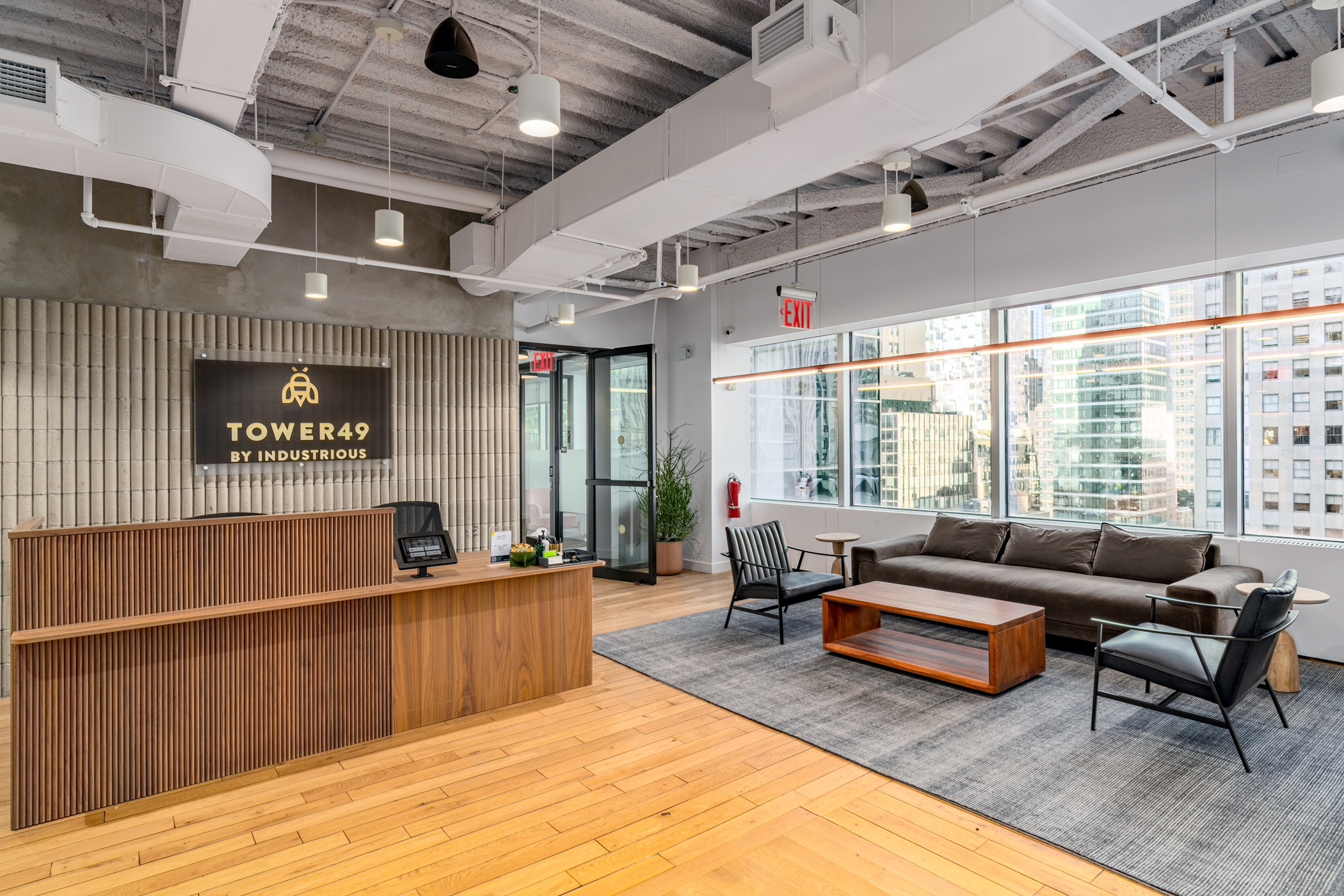
Phil Mobley, CoStar's national director of office analytics, met with Levine recently at Tower 49, Industrious' flagship location in Midtown Manhattan, to discuss the current and future state of the flexible workplace segment. An edited transcript of their conversation follows.
CoStar: Flexible workplaces are used by everyone from independent contractors to global enterprises. How do you think about segmenting the market? Which segment(s) is/are growing fastest?
Anna Squires Levine: Our industry often conflates team size with the problem to be solved. Individuals are trying to solve a time or connection problem. They either need a place to work that's close to home but not their home, or they are lonely working at home.
For larger teams of 100 people or more, whether part of a medium-sized or large organization, it's about collaboration. But it also becomes about the problems decision-makers are facing.
Broadly, we think about solving problems for individuals, for medium-sized teams and for large teams. That drives where we put our locations. For example, the Lincoln Center for Performing Arts in Manhattan is surrounded by people who can walk there. They are looking for a place to work that they can walk to after dropping their kids off. That's a very different need than a large team that needs space.
So for individuals, we want to help them maximize their time and human connection, which is why locations near residential areas serve them well. They can meet other members for lunch or learn what others are working on.
For medium-sized teams, the question is, "How do I get my team to work together?" It can be pretty chunky because most firms haven't built out a technical infrastructure for distributed, asynchronous work. They might also be doing a lot of hiring and need a place to meet recruits. Or maybe they need to host investors or customers.
Then, at the enterprise level, it becomes more of a financial decision.
CoStar: Given these different sets of needs, what kinds of locations perform best for Industrious?
Levine: It's all been on fire ever since vaccines came out. We can see in our data when that happened. Practically, we are focused on growing locations that serve that middle group. That's the sweet spot, the core Industrious business.
But the biggest percentage growth will be in the other two. We've just rolled out a managed suites product for enterprise clients of CBRE, and they don't need to be connected to an existing Industrious location.
And then we have Indy, which is focused on individuals. That is not necessarily synonymous with freelancers — many of them are employees of large organizations, and they use the network in mutually supportive ways. They might gather in one location in Midtown on one day, then disperse across the city for the rest of the week.
CoStar: How many of your individual customers regularly use more than one location?
Levine: About a quarter of our members regularly use more than one Industrious location, and a little over 10% are what we call "super users," regularly using five or more locations. That includes both those who are using different locations within a city and those who travel to different cities around the world.
CoStar: How do you know when Industrious has successfully delivered for customers?
Levine: The beauty of this business is that our customers can vote with their feet. They either pay us or they don't. So if they grow up with us and stay, that's success. We also track sentiment, both NPS [net promoter score] and comments, so we get a full picture.
CoStar: What is the right scale for flexible workplace solutions within the office market today, both within a given building and across the industry?
Levine: In London, which is the most advanced flex work city, it is 12% to 13% of the market and growing. If New York is at 3% to 4%, there should be room to grow.
It's not really about the share of the building, but about the demand from people who want to work in it. We have some locations where we have all or most of the building. Some [building] ownership structures support that, and others don't.
CoStar: On that topic, have you seen a change in perspective about flexible work within the institutional investment and lending community, which has been nervous about a revenue stream that is less predictable than the long-term lease?
Levine: We are still accelerating our number of locations, so it hasn't slowed us down. Our model is to partner with landlords so that we both have skin in the game. When things are going well, they can make more money.
What will move the needle is that owners are increasingly hearing from the market that they need a flex offering in their buildings. Also, those who are repositioning their buildings and seeking new tenants like to know they can have someone who is experienced in operating a flex platform, including a building-wide amenity offering.
CoStar: How do you expect flexible workplaces to play in the current environment characterized by the rapid diminishment in the availability of leasable first-generation office space?
Levine: It should be an opportunity for landlords to make their buildings more attractive, and that includes Class B buildings. We have some Class B locations that do amazingly well. New, shiny buildings can also do amazingly well, but there are important things to consider. There is only so much that glass and steel can do for a workplace experience, and there are still a lot of organizations that don't want to pay that new, shiny rent.