The use of credit cards has increased dramatically over the past few years.
Not only are transient guests using credit cards to pay for their guestrooms and incidentals, but group and event planners are now paying their master bills for conventions and banquets with a credit card. Ease of payment, affinity program points and the dwindling use of checks are frequently cited as reasons for this trend.
The increase in credit card use has both positive and negative impacts. Credit card commission payments are on the rise, but the risk of collection of accounts receivable has declined. Now, as of 1 October 2015, the issue of credit card fraud liability has entered the conversation as well.
To provide some context to the recent increase in discussions about credit cards we provide some information about chip-enabled credit cards, credit card commissions and the rise in the use of credit cards as a form of payment.
What Is EMV?
On 1 October 2015 there was a shift in liability for those who accept credit cards as a form of payment. EMV—or what is commonly referred to as chip-enabled credit cards—are being issued by U.S. credit card companies to their cardholders. EMV stands for Europay, MasterCard and Visa, which were the first three companies to create the standard for the chip system. Subsequently, all the other major credit card companies have followed suit.
Prior to 1 October, the credit card companies took responsibility for “card-present” fraudulent transactions, which are transactions that are done face to face. After 1 October, whichever party has not invested in EMV technology will now have the liability of a card-present fraud transaction. Given the proliferation of credit card use in hotels, this can become a significant cost.
Merchants need to replace their payment terminals, which can be a costly expenditure depending on the type of terminals selected and quantity of terminals needed. Some merchants that have already changed their terminals are offering the option of “chip and signature,” where they allow the customer to insert the chip card and use a signature instead of a pin.
However, this does not provide the full fraud security benefit that “chip and pin” offers. Even though the date has passed, the acceptance of “chip and pin” or “chip and signature” only addresses one form of fraud: card-present transactions. It does not address card-not-present (internet) transactions nor protect against fraud after a data breach, which can partially be mitigated by tokenization and point-to-point encryption of credit card numbers.
Credit card use
To estimate the use of credit cards at U.S. hotels, CBRE Hotels’ Americas Research analyzed the credit card commissions and total revenue line items reported on the operating statements of U.S. hotels during the period 2007 through 2014. This data comes from CBRE’s annual “Trends in the hotel industry” survey. Additional assumptions were made using information from the following sources:
- Credit card discount rates were estimated from a survey of hotel financial executives;
- lodging and sales tax estimates were made based on information from public sources; and
- gratuity assumptions were derived from our general industry knowledge and revenue mix data taken from the CBRE Trends database.

Credit card commission payments measured as a percent of total revenue increased each year from 2007 (2.01% of total revenue) to 2014 (2.22%). Concurrently total revenue for the properties in the “Trends” sample grew by 5.9%. The combination of the two metrics implies a strong 17% increase in credit commission payments during the same period.

To gauge the use of credit cards by hotel guests, we applied the credit card commission data to the discount rate, tax, and gratuity assumptions cited previously in this article. Based on this analysis, CBRE estimates that 83.4% of total hotel revenue was paid for with credit cards in 2014. This is 7.2% greater than in 2007, when 77.8% of guest transactions were paid by credit card.
Doubtful accounts down
According to the 10th edition of the “Uniform System of Accounts for the Lodging Industry,” provision for doubtful accounts is used to track changes made to provide for the probable loss on accounts and notes receivable. Each month, hotel managers estimate the portion of their property’s receivables that they do not believe will be collectible.
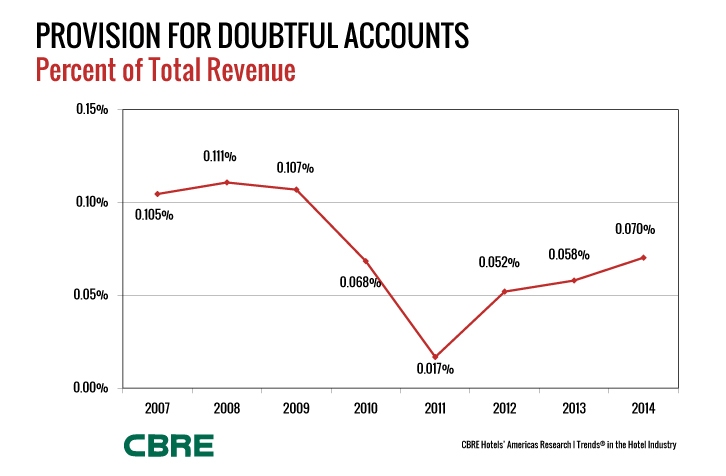
The provision for doubtful accounts peaked at 0.11% of total revenue in 2008 during the depths of the Great Recession. This ratio bottomed-out in 2011 at less than 0.02%. It can be assumed that conservative credit controls put in place during the recession helped to lower bad debts.
Since then we have seen a slight uptick in the provision for doubtful accounts as a percent of revenue, however, the 0.07% mark posted in 2014 is still lower than the pre-recession 2007 figure of 0.105%. We attribute the decline over the seven-year period to the increased use of credit cards, which gives some degree of greater assurance of collection.
Concern and conversation
While the increased use of credit cards has made collection easier, the cost of commissions and potential cost of fraud is on the rise.
For these reasons, it is not surprising that credit cards have been a big topic of concern and conversation among hotel controllers and directors of finance.
Robert Mandelbaum is Director of Research Information Services for CBRE Hotels’ Americas Research. Dennis DuBois is Senior Director of Finance, Managed Hotels, Americas for Carlson Rezidor Hotel Group, and provided the EMV content.