
The price tag behind what's expected to be Goldman Sachs’ largest U.S. office campus has climbed more than 40% in the few years since it was announced, one sign of rising construction costs across the country.
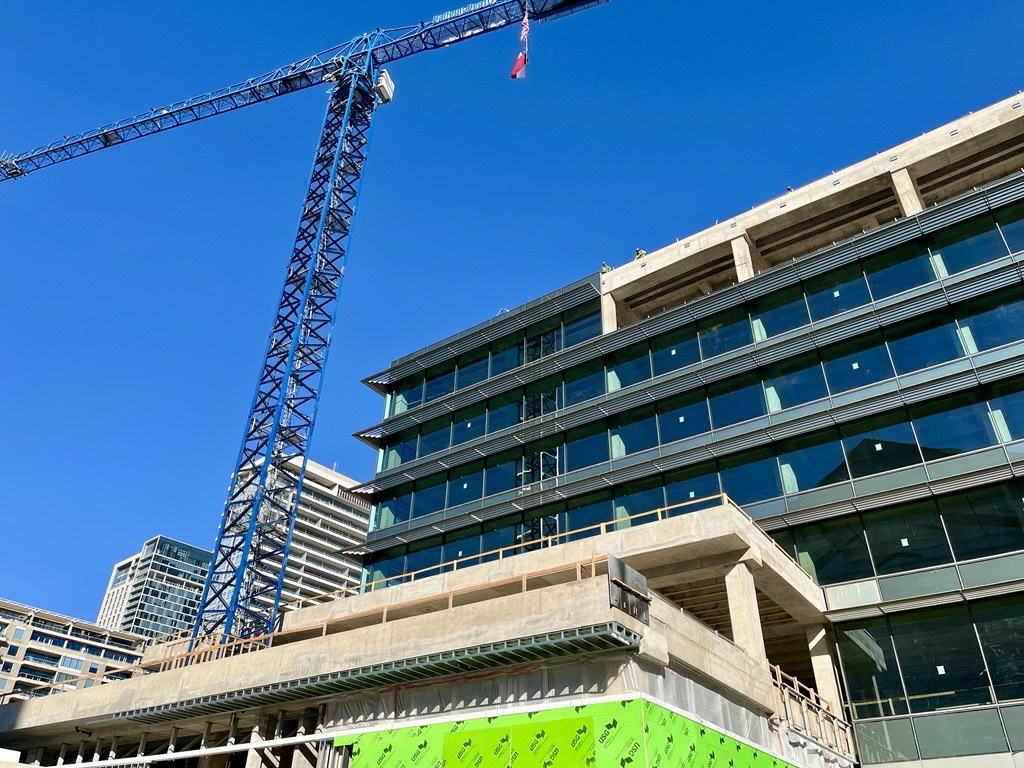
The New York City-based financial giant's Dallas campus under construction in Victory Park, just north of downtown, is expected to run at least $709 million, according to work permits filed with the state. That's more than the nearly $500 million price in 2022, when the city of Dallas approved the project and granted about $18 million in economic incentives.
Goldman Sachs' filed last week a state work permit for building out the interiors with an estimated price tag of at least $209 million at the two-building, 800,000-square-foot Dallas campus expected to open in 2028. When asked about the apparent price change, Goldman Sachs deferred to the public filings.
Broadly speaking, U.S. development is getting more expensive as construction has been hit by elevated interest rates, cautious lending and uncertain supply and demand fundamentals, Cushman & Wakefield Senior Economist James Bohnaker told CoStar News.
"Construction costs are still rising, modestly speaking, even as construction is broadly down compared to last year and especially a couple of years ago," said Bohnaker, excluding data center projects.
Without the current lull in construction activity, prices could be even higher, he said.
"Costs are going up," Bohnaker said in an interview. "When you budget these projects years in advance, it will cost one thing but plans and costs are changing. Perhaps someone wants the fitness center to have a spa. That will add to the costs." Bohnaker is not involved in the Goldman Sachs construction project.
Workspace for 5,000
Goldman Sachs' new Dallas office, expected to be the largest by physical size in its U.S. portfolio, includes a 1.5-acre adjacent park, retail space and a variety of amenities for an initial 5,000 workers, as CoStar News has reported. The campus is also designed with room for Goldman Sachs to continue growing its business in Texas.
The firm's New York City headquarters, with nearly 2.2 million square feet of office space, is in a single tower and the company doesn't consider it a campus like the one being built in Dallas.
The Dallas campus has open-layout workspaces, modern conference rooms and a range of common areas meant to foster collaboration. Other amenities include a full-service fitness center, food hall with multiple dining options, a childcare center, outdoor terraces, rooftop gardens, coffee bars and social lounges.
The campus is expected to house "every aspect of an employee's daily life" from childcare to morning workouts to quality coffee breaks and food service," designers of the campus said in a statement from Goldman Sachs last month.


More employers are offering enhanced amenities meant to mimic features found in luxury hotels and upscale tourist destinations to recruit and retain workers, the Urban Land Institute said in its annual "Emerging Trends in Real Estate" report released last week.
That often means including a swanky fitness center with country club-style locker rooms and space for private trainers. Or adding culinary lunch menus and high-end food halls. Even an office building’s roof deck is no longer sufficient — employees want the space to mimic a club, and many rooftop areas are so fancy that renting them out for private events is becoming the norm, ULI said in the report.
"High-profile projects also tend to have a lot of amenities and all those things cost a lot of money," Bohnaker added.
Tariff uncertainty
Bohnaker recently wrote a report for Cushman & Wakefield on how tariffs are adding another layer of uncertainty to the equation, complicating decisions and amplifying cost pressures for developers, contractors and occupiers.
Even without amenities, Bohnaker said the cost of just the building's four walls is going up.

Cushman & Wakefield's analysis in the report found that tariffs on imported building materials are expected to increase the total cost of construction by an average of 4.6% in the fourth quarter of 2025 compared to costs from the same quarter last year. Tariffs on steel took effect in February, with them doubling from 25% to 50% in June, the White House said. A 10% tariff on imported timber and lumber began in mid-October, with 25% tariffs on furniture and finished wooden goods like vanities and cabinets.
Those price increases tied to tariffs have yet to be felt in the construction market, Bohnaker told CoStar News, making it unlikely that Goldman Sachs' increased price tag includes tariff impacts since most companies' product imports predated tariffs.
"Companies were trying to import these goods before tariffs went into place," he said, adding this includes products such as lumber and steel. "We are still in the early days of feeling the price increases of what could be happening in building materials."
For large companies with "tons of cash," these cost pressures might not be a big issue, he added, but for speculative development that takes a certain level of math to make the numbers work — it could delay or cancel some of these projects.
"Directionally speaking, the price pressures are in an upward direction," he said, adding it's difficult to forecast what construction prices could do next year. "For where we are today, the rate of increase will continue to go up."