
A water taxi bobbing in Baltimore’s Inner Harbor provides a unique vantage point for observing the evolution, and fragmentation, taking place in the heart of the historic city.
Looking west to east along the horizon, 1970s office buildings give way to 1980s tourist spots, then early 2000s high-end hotels and condos. Now, scattered further east and south, competing residential and corporate headquarters developments are emerging in a fight for supremacy.
Baltimore's center of gravity is shifting, but instead of moving in one clear direction, it's getting pulled in many, in fits and starts, complicating the city's recovery.
The identity of Baltimore nationally has long been centered on a so-called festival marketplace of retailers on the water's edge, designed as a draw for tourists and a destination for downtown office workers. But the office market has steadily declined, and the Inner Harbor is no longer the anchor it once was, beset by high vacancies. Some of the area's best-known office tenants have decamped to other parts of the city, seeking a fresh atmosphere and modern amenities.
Still, the harbor remains a draw. Several developers have sought to capitalize on this exodus by launching ambitious plans to reclaim and redevelop former industrial properties that once served Baltimore's blue-collar past into new communities, creating a web of distinct neighborhoods.
The site of the retail pavilions at the harbor's core is slated to be transformed into new shopping and dining, public space and apartments. Another project, the 27-acre Harbor Point, is rising from a former brownfield site where a factory once processed chromium. It's now the headquarters for investment management giant T. Rowe Price.
Plus, a 177-acre project is taking shape across the water at what is now known as Baltimore Peninsula. That's where sportswear maker Under Armour now makes its home, a mixed-use community of apartments, office buildings and even a roughly 1,400-seat stadium used in part for hosting high school football games. That area's future remains less clear given that its main developer said this fall it would exit the project.
Each development offers potential lessons for revitalization of an urban shoreline, though the efforts face plenty of challenges and no guarantees, from navigating a complicated tax financing system to a lack of reliable public transit, to broader misperceptions about safety in the city. Plus, the absence of clear signs between the hodgepodge of projects could hamper tourists and area residents from making full use of each development.
Office struggles
From the water taxi in the harbor, an office market is visible on the western horizon that's struggling with low demand, even while other workplace hubs around the country have begun to rebound from the pandemic.
“The office market is a complete disaster. It is just a disaster," David Bramble, a managing partner at MCB Real Estate, the developer remaking the core section of Inner Harbor, said in an interview. "The pandemic destroyed office in Baltimore, and it did the same thing in many other places. Baltimore is not unique in that way."
Across greater Baltimore, as in several other U.S. cities, the office market has struggled with issues of oversupply, especially among its aging properties, as tenants seek glitzier spaces. The area's office vacancy rate stands at 12.5%, according to a CoStar Market Analytics report.

Before it was dominated by office towers, the city predominantly relied on the water to facilitate business. Still a working seaport, Baltimore’s industrial Inner Harbor drove the metropolitan area’s economy throughout the late 19th and early 20th centuries.
Several iterations of plans to remake the downtown and waterfront continued over the decades, especially as transportation networks across the country changed the nature of commerce. By 1980, developer The Rouse Co. completed the permanent festival marketplace retail buildings that remain in place today. Fast forward to the present, and the central office market is largely in a state of decline.
T. Rowe’s intra-Baltimore relocation to a new office building left its former home, the 1970s-era office tower at 100 E Pratt St. near the Inner Harbor, largely vacant. The property's situation is expected to be exacerbated when next summer PricewaterhouseCoopers exits the same building for a newer development. Moreover, giant real estate services firms JLL and CBRE announced moves in the past year from downtown to the higher-end, and newer, neighborhood of Harbor East.
Even Maryland state officials are looking to relocate state agencies out of certain properties they said would require “significant infrastructure investments," meaning it would be more cost effective to lease other commercial space than renovate or modernize some existing government properties.


Contractions and relocations also are occurring on the outskirts of the city and contributing significantly to occupancy loss, a recent report from CBRE said. As in other cities, some of Baltimore's outdated office properties have been converted to residential use.
In line with all of that, developers throughout the metropolitan area are seeking to maximize underutilized space along the picturesque waterfront to offer a modern live-work-play environment.
Moving beyond tourism
Despite the sounds of heavy traffic on nearby Pratt Street on an overcast morning, few passersby traversed the faded red-brick waterfront walkway at the center of the Inner Harbor. South of the city’s traditional downtown office scene, the main section of Inner Harbor is home to the aquarium and the Maryland Science Center.
“I hear stories from people who’ve experienced what the harbor was like years ago. It’s very different than what it is now," Baltimore native Chi Akano told CoStar News. "It’s obvious that this place used to be a place where people gathered, a place that really held a spot in the community, but it’s not really that anymore.”
“There’s this effort to revamp everything and redevelop, but when is that going to happen?" said Akano, who works at the cafe, Matriarch Coffee, in the heart of Inner Harbor.

One planned project is MCB Real Estate's Harborplace. The development firm acquired property that had fallen into receivership in 2023 for the project.
MCB put forward plans to revamp the cornerstone of the waterfront that’s become a vestige of its past life. The site currently hosts a pair of two-story, aging retail pavilions, 201 E. Pratt St. and 301 Light St., that CoStar data shows total approximately 165,000 square feet.
MCB has proposed a $900 million new backyard for Baltimore’s current and future employees, residents and visitors to the site. The project would contain new commercial space for retail and dining, a two-tower residential property, and approximately 18.7 acres of public space that's larger than the site’s existing such acreage.
The developer is betting the ship has not yet sailed on creating a new heyday for Inner Harbor. “The Sail,” a roughly 200,000-square-foot mixed-use project at 201 E. Pratt St. would be shaped as its nautical name suggests, according to a fact sheet shared with CoStar News. It would predominately house food and beverage options covered by amphitheater-style public space that slopes downward toward the harbor.
To its east, a roughly 200,000-square-foot commercial property is planned at 203 E. Pratt St. A smaller retail pavilion with 8,500 square feet of enclosed space at 301 Light St. — the northwest corner of Inner Harbor — would feature a park.
Just south of that, a two-tower, mixed-use residential project at 303 Light St. would bring new housing to the harbor. The 25-story North Tower and the 32-story South Tower would in total contain about 900 rental units, plus retail and community space.
MCB said it hopes to start construction before the end of 2026 and currently anticipates the project would take approximately seven years. “In my mind, the key to this is making it so that it’s a walkable, enjoyable, accessible place,” MCB’s Bramble said.
Across the harbor from the aquarium, the ongoing redevelopment of the public park Rash Field is adding recreation and greenspace to the edge of the waterfront. It opened its first phase in the fall of 2021 with a lively skate park and playground. A second phase of that park expected to include a grass lawn and beach volleyball courts is slated to be completed by summer 2026.
T. Rowe Price's new neighborhood
From the water taxi in the harbor, looking east along the waterfront, a Marriott hotel completed in 2001 acts as a gateway between the well-known core of Inner Harbor and an aptly named neighborhood, Harbor East. That area features a heavy concentration of high-end retail, from clothing chain South Moon Under to beauty product retailer Sephora.
The waterfront, in practice, has not been collectively master planned. Developers are building out new or revising mixed-use neighborhoods with office properties featuring more amenities, high-end apartment buildings, luxury hospitality space and retail space to draw in crowds.
That is the case further along the waterfront's eastern edge where a peninsula that once hosted an industrial facility used for processing chromium, a chemical used to produce stainless steel, juts out into the water. Now known as Harbor Point, Beatty Development Group said it would invest $1 billion to transform the site into a new neighborhood anchored by the 550,000-square-foot T. Rowe Price headquarters. Approximately 2,000 employees work at the property four workdays each week, a company spokesperson told CoStar News via email.

The area also features another three new office buildings, two new apartment complexes and at least half a dozen new retail spots. On the ground floor of the more-than-20-story mixed-use property known as the Constellation Tower, named for its anchor tenant, a Korean fried chicken joint welcomes a hungry lunch crowd.
“People back to office definitely will bring a lot of benefits to small business,” Na Yi, owner of The Chicken Lab restaurant, told CoStar News. It held its grand opening at the beginning of October. She also owns Charm City Poke & Mochi, another retail spot at the base of the property.
Yi, who’s lived in Baltimore for about 25 years, said employees working in person across the street at T. Rowe Price have been a huge part of the restaurants’ success. Weekends can be slower, she said, but as new residents move in, business will be even better over time.
Other properties at Beatty's Harbor Point include the Thames Street Wharf office building, the Wills Wharf office building that includes 156 hospitality units and the apartment complexes known as 1405 Point and Allied Harbor Point. Plus, another 250-unit tower at Allied Harbor Point and a 152-key Residence Inn by Marriott are on their way, along with a proposed multi-tower mixed-use project that Beatty told CoStar News could have between 700 to 1,000 residential units, a 120- to 150-key hotel and office and retail space.
Community emerges off main waterfront
Heading west back along the waterfront's edge, a 20-minute drive south from the Harborplace retail pavilions down Light Street takes visitors to an area once known as Port Covington. The site has been rebranded as Baltimore Peninsula, where its now-former developer, MAG Partners, built a pair of office projects, a pair of multifamily properties, a joint hospitality-multifamily building and about half a dozen retail shops.
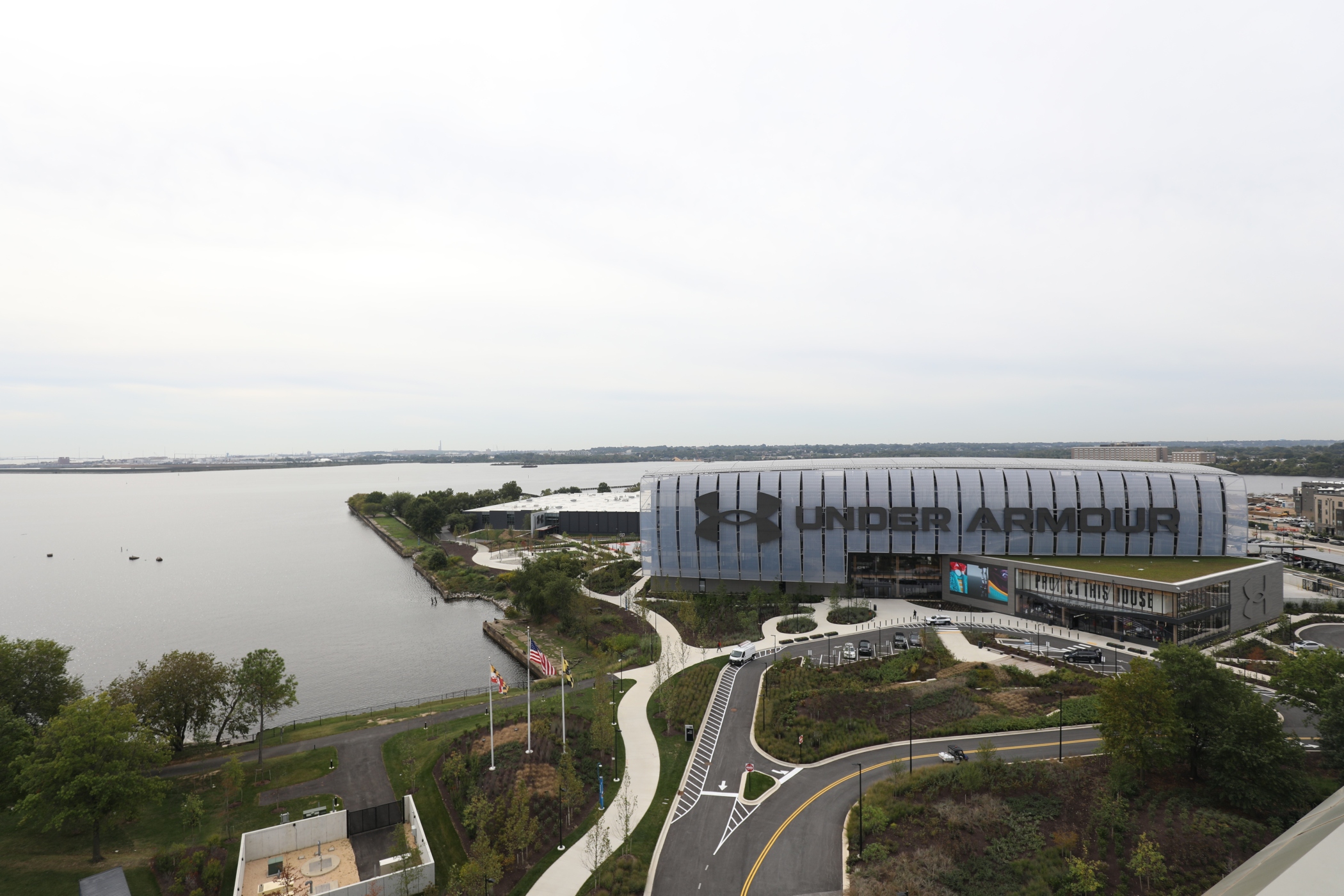
The area is anchored by Under Armour’s corporate campus that features a five-story, 280,000-square-foot headquarters. About 1,500 employees work at the complex, and they have been reporting to their offices four days a week since early September, according to a company spokesperson. At one point, the area was proposed to be the home of tech giant Amazon’s second headquarters, though Northern Virginia was chosen for that project, known as HQ2.
While it was still involved in the Baltimore Peninsula, MAG Partners told CoStar News on a walking tour that Baltimore Peninsula could see further development across different commercial sectors. It could also potentially house a soccer complex where the Baltimore Sun printing plant once stood, according to The Maryland Stadium Authority.
The realization of all of that, however, remains unclear. MAG has said it plans to exit from the Baltimore Peninsula project.
"As our role in this work changes, we are proud to leave Baltimore Peninsula stronger than ever and are glad the neighborhood will be guided by the Baltimore Peninsula Partnership, the business improvement district we helped launch," MAG Partners said in an email statement to CoStar News.
Facing challenges, breaking misconceptions
To bring their projects to life, both Beatty and the Baltimore Peninsula development team received a tax increment financing, or TIF, package from the city. That’s a source of funding for public infrastructure such as roads or lighting, that helps developers build projects that otherwise might not be realized. Beatty received $107 million in TIF funds in 2013, and the Baltimore Peninsula development team was allotted a $660 million TIF package in 2016.
The projects can look for guidance from developments in other cities that took advantage of tax increment financing, including for waterfront developments such as The Wharf in Washington, D.C. The District supported the roughly 3-million-square-foot mixed-use development with $198 million of TIF bonds, and said this summer it collected tax revenues sufficient to fully repay all of the outstanding bonds related to the project 15 years before their scheduled maturity. Sales and real property taxes generated there, now totaling more than $50 million annually, will become available for use in the city's general fund.
In order to repay the borrowed funds, the Baltimore waterfront projects need to generate revenue because the funding is tied to incremental taxes created by the developments. That comes, in part, by distancing themselves from certain rhetoric and perceptions about the city.
President Donald Trump this summer called Baltimore “out of control” and “crime ridden” on social media, even stating he would potentially send troops to the city as he’s done in the nation’s capital. However, homicides and non-fatal shootings, are declining, Baltimore's mayor said in October.
Meanwhile, Baltimore is trailing nearby cities such as Washington, D.C., and Richmond, Virginia, in regard to job growth, according to a recent regional economic snapshot from the nonprofit group Greater Washington Partnership. While some job losses can be attributed to cuts to the federal workforce, there have been recent months of employment gains in Maryland as well.
Lessons to learn
“To reinvent Baltimore’s downtown for the next century, the city must both take guidance from the past and be willing to break from established paradigms that arose during the preceding six decades,” said MCB's Bramble and Tracy Hadden Loh of Brookings in a recent Urban Land magazine article.
“The challenges and opportunities in such an endeavor are vast. Nevertheless, choosing to reposition aging infrastructure, revitalize disinvested corridors, and revise assumptions from previous generations as catalysts for economic growth are steps all cities can take as they seek to modernize themselves to reflect a vision for the 21st century and beyond,” MCB’s Bramble and Loh continued in their commentary.
There are lessons to be learned, they noted, from observing how other cities have handled underperforming land parcels left behind by urban renewal and or deindustrialization shifts. And, Bramble and Loh explained, an emerging set of global best practices in waterfront development exists that could be applicable to Baltimore. They include promenades, public parks and piers, mixed-use density and an orientation toward the pedestrian experience.
“I want this whole area to be populated with people who live in Baltimore City who are coming down because this is a great place to spend their time. I think that becomes the place where, if you’re a tourist, you want to be,” Dan Taylor, president of the Waterfront Partnership of Baltimore, told CoStar News during a walking tour.
To achieve that, his nonprofit organization has proposed a wayfinding initiative, similar to those at The High Line in New York City, that would use concise signage to better direct pedestrians around the waterfront.
Taylor said he hopes such a move, estimated to cost just over $1 million, would improve connections and drive traffic between the commercial districts that are partly isolated from one another so that the various redevelopments better succeed.
“The entirety of this waterfront needs to be successful, or none of it will be successful,” Taylor said.