
New York City has been the nation's leading financial center, with Manhattan's Wall Street, home to the New York Stock Exchange and the Federal Reserve, serving as the historic and symbolic anchor of U.S. finance for centuries. That shows signs of changing.
The financial industry is evolving beyond its Wall Street roots, tapping talent across the country as more wealthy residents move to escape states with higher taxes and regulations. Beyond New York, Dallas earned the moniker of "Y'all Street," while South Florida is called the "Wall Street of the South" as financial institutions follow talent and investment capital. It's setting up a clash of three very different cultures in areas that would like to be considered the nation's financial hub.
The Texas Stock Exchange, a new, purely electronic national securities platform, is scheduled to launch live trading this month as a rival to the storied NYSE and Nasdaq, where regulations and costs have been increasing.
The Texas Stock Exchange's goal is to bring “real competition to corporate listings” and the “potential to transform the U.S. public markets," according to its website. The online page touts a Texas longhorn with a banner saying, "Welcome to the real bull market," a reference to the well-known statue of a bull near the NYSE in Lower Manhattan.
Plans for the Texas Stock Exchange were announced two years ago with backing from some of the world's largest investors, including BlackRock, Citadel Securities and Fortress Investment Group. The Dallas-based exchange wants to eventually establish an iconic market opening and closing ceremony — like the NYSE's ringing of a bell. It's in talks to potentially shoot off a cannon to mark the opening and closing of trading at a public park across the street from the exchange's future headquarters in Uptown Dallas.

The Dallas-Fort Worth area now ranks as the nation's second-largest financial market outside of New York City, according to the Urban Land Institute's 2026 Emerging Trends in Real Estate report.
That means multibillion-dollar investments in real estate: Morgan Stanley is planning to build a $1.3 billion hub in Uptown Dallas, and Goldman Sachs is nearing construction on a highly anticipated two-building, 800,000-square-foot campus. Bank of America is building its new namesake office structure with 30 stories and more than 500,000 square feet with a potential rolling ticker for the Texas Stock Exchange, just blocks from the Federal Reserve Bank of Dallas.

"There's nothing mysterious about it," said Susan Arledge, a senior managing director at real estate advisory firm Newmark, who has spent decades helping financial services firms find offices in the United States. "They are following the labor. They are birds of a feather; they want to locate where there's a deep pool of concentrated talent."
Miami's allure
The pandemic served as the catalyst for South Florida’s emergence as a finance and tech hub. Executives from across the country who temporarily relocated to the region to escape COVID-related restrictions were soon convinced to stay.
Political leaders, eager to recruit finance firms to the area, coined the term Wall Street of the South, with two cities — Miami and West Palm Beach — emerging as the poles of a growing and robust financial system, similar to New York City and Greenwich, Connecticut, albeit with year-round sunshine, warm sandy beaches and boating on crystal blue waterways.
Since 2022, South Florida has attracted major financial institutions, including Morgan Stanley, Wells Fargo, Merrill Lynch, Goldman Sachs, Elliott Management and, perhaps most notably, the headquarters relocation of the $67 billion hedge fund Citadel and its billionaire CEO, Ken Griffin.
The lure of a rich financial services talent pool can grow as financial firms — like investors — gravitate in a herd-like mentality to what are seen as strategically located U.S. hubs, Arledge said.
And it shows up in the numbers: Jobs and gross domestic product from the finance, real estate and professional services sectors in Dallas, Miami and New York City as a percentage of total employment and GDP are higher than the U.S. average, according to Oxford Economics.
Miami International Holdings opened its first securities facility with a trading floor and electronic exchange in 2025 with the Miax Sapphire options exchange in the city's Wynwood arts district.
Miax established a trading floor in Miami "for a whole bunch of different reasons," but at the top of the list: the absence of a state income tax, and access to talent and firms that want to operate in that environment, said Andy Nybo, senior vice president and chief communications officer at Miax.
"The Wynwood location, it has about a 9,000-square-foot trading floor. The space itself is about 38,000 square feet," Nybo told CoStar News. "It's got incredible views north, south and east toward the ocean. There are not many trading floors that can boast the kind of views we have."

And while New York City is home to the most residents in the world with an estimated wealth of $100 million or more, some South Florida markets and Dallas are emerging as fast-growing hubs for the ultrawealthy, according to a 2025 report from Henley & Partners, a research and consultancy firm.
Dallas, Miami and West Palm Beach were cited for their strong growth potential over the next decade when it comes to attracting super-rich residents.
For employees starting out in the industry, Arledge said, it has gotten increasingly difficult to afford to live in New York City.
Still, that didn’t stop JPMorgan Chase, a bank with $4.9 trillion in assets that makes it the nation's largest, from completing its $4 billion Manhattan headquarters last year.
Using the biggest U.S. bank as a guide, CoStar News took a deeper look into where Chase expects employees to be in the office five days a week — in some of the most important financial areas in the country. Here's how the three regions match up:
Manhattan headquarters

The vibe: At lunchtime on a recent weekday with temperatures hovering in the low 80s, Chase employees stream in and out of the company’s headquarters in midtown. Their dress reflects a broader shift among Manhattan office workers, with comfort largely replacing formality, and ties, heels and suits rarely seen. Many employees paired polos or dress shirts — sometimes untucked — with slacks and sneakers such as Adidas Sambas and other casual footwear. Their food choices ranged widely, from fast-casual chains such as Chopt and Sweetgreen to Naya’s Mediterranean fare, Chipotle, Mangia’s prepared Italian foods, and Duke Eatery’s deli sandwiches and hot dishes that typically range from $15 to $20. Some ate in the public plaza outside the building, while nearby food trucks added to the typical midtown lunch scene. For more formal meals, upscale restaurants such as Fasano are directly across the street or around the corner, while others — including The Capital Grille, Bobby Van’s and Daniel Boulud’s Le Pavillon in SL Green Realty’s One Vanderbilt — are within a few blocks. Lunch at those places can run about $40 to $80 per person, and much higher.
The property: Chase demolished its former 52-story headquarters building, where it and other banks it combined with over the years had been headquartered since about 1980, to make way for the new 60-story headquarters at 270 Park Ave. The building takes up a full block bounded by Madison and Park avenues and 47th and 48th streets, about a half-hour subway ride from the NYSE in Lower Manhattan. Designed by Foster + Partners and owned by Chase, the 2.5 million-square-foot, 1,388-foot-tall tower is billed as the largest all-electric skyscraper in North America and features a fan column structure and triangular bracing that create 2.5 times as much public space at street level as the previous building. The new building also features eight expansive trading floors, according to Foster + Partners.
The tower’s opening, along with wider sidewalks and a new public plaza, has helped revive an office district that emptied out during the height of the pandemic. Vacancy among top-tier office buildings in Midtown East has fallen into the low single digits, with top asking rents exceeding $300 per square foot, according to real estate executives and brokerage reports.
The team: 270 Park houses about 10,000 of the company’s employees, and its website says it’s designed to accommodate more than 14,000. The headquarters houses employees across various departments and executive offices, including that of longtime chairman and CEO Jamie Dimon.

Campus perks: Designed to be a “city within a city,” 270 Park includes more than 20 dining concepts, a curated retail shop, and a fitness and wellness center offering services such as consultations with a registered dietitian. Food options include Sweetgreen and Daily Provisions, a concept from restaurateur Danny Meyer, along with the vegetarian eatery Little Dirt Candy from Michelin-starred chef Amanda Cohen. The building also features Morgan’s, an employee-only pub on the 13th floor with about 50 seats serving English and Irish fare such as shepherd’s pie, along with beer and other drinks. The pub has proved popular, with reservations reportedly booked weeks in advance.
The commute: 270 Park sits in the Plaza District, one of the most expensive office clusters in the United States, and has a direct underground connection from just outside the building to Grand Central Terminal. In the evenings, employees can often be seen heading to Grand Central Terminal, where Metro-North trains carry commuters to suburbs in Westchester County and Connecticut, while the Long Island Rail Road provides direct service to Long Island. They can also pay $3 for a subway ride across the city. Like many Midtown office towers, the property does not include on-site parking. Transit access and dining options are only part of the draw. Some employees returning from lunch carried shopping bags from nearby retailers such as Adidas, Aritzia and Saks Fifth Avenue. Landmarks including Rockefeller Center and Bryant Park are also within a short walk, along with hotels such as the newly renovated Waldorf Astoria. For employees who want the luxury of walking to work, the average monthly market asking rent in the surrounding Midtown East neighborhood has risen to a record high of $5,132 per unit, well above the city average of $3,637, also a record high, according to CoStar data.
Plano, Texas, suburban campus

The vibe: A group of 20-something Chase workers exits the side gate of the bank's sprawling campus in Plano, Texas, a Dallas suburb roughly 20 miles north of downtown, on a weekday in June. The workers, all wearing sneakers or sandals with slacks, untucked buttoned shirts and blouses, trek through temperatures in the low 90s for roughly a quarter mile on the uncovered sidewalk along Communications Parkway. They're heading to Legacy Hall, a food hall that offers sushi, tacos, pizza and wine on tap to the masses that work for corporate giants in Legacy West like Chase, Boeing, Sally Beauty Supply and Toyota North America. An order of two tacos and a side of elote — Mexican street corn — from Velvet Taco, without a beverage, costs about $20. Most employees use the time to catch up with colleagues outside the office and watch a World Cup game. The food hall opens at 10 a.m. and closes at 10 p.m. Monday through Thursday, with a Friday closing at 1 a.m. The lunch rush is highly corporate, transforming into a sports fan feeling after 2 p.m. for the World Cup game. Employees also frequent Legacy Hall for happy hour and wait for traffic to calm before hitting the roadways. Across the street from the food hall are luxury retailers such as Gucci, Tiffany & Co. and Golden Goose.
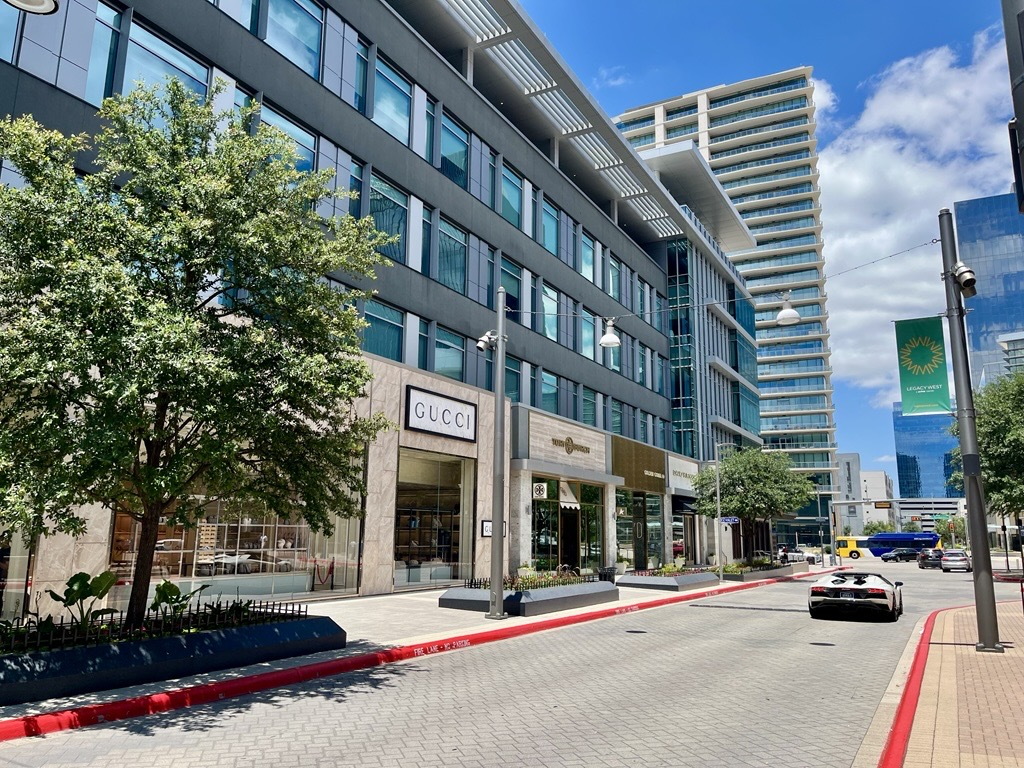
The property: Chase owns its 50-acre campus in Plano. Chase started building the campus at the Legacy West mixed-use development in 2016 and opened it with 6,000 employees in 2017. Chase has since expanded its real estate and staffing at the Plano hub to more than 12,000 workers. The city of Plano offered Chase about $5 million in economic incentives, and now Plano is Chase’s largest employment hub in North Texas, spanning about 1.5 million square feet of office space across four buildings that range in height from seven to 12 stories. Dallas-based architecture firm HKS designed the campus with inspiration from a minimal artist known for landscape installations in Marfa, Texas, leaning into exposed concrete and steel throughout the campus, as well as fluorescent tube lighting. The campus is powered in part by a wind farm southwest of Fort Worth. Chase owns its campus; other businesses in Plano pay office rent averaging about $40 per square foot, according to CoStar data.
The team: About 12,500 employees work at the Plano campus, and the bank is trying to fill 800 open jobs there. Workers at the Plano campus handle regional operations, technology and analytics, according to current job postings. In the greater Dallas-Fort Worth region, Chase has about 17,500 employees, more than half its nearly 30,000 workers in Texas. Chase also has a large office in downtown Dallas at the Hunt Consolidated tower facing Klyde Warren Park as well as an office in Fort Worth.

Campus perks: Chase employees also can pay to eat within the campus at a 40,000-square-foot dining hall run by Aramark. The on-site dining hall offers breakfast hours from 7 a.m. to 10 a.m. and lunch hours from 11 a.m. to 2 p.m. The campus has a free fitness center, employee game area with billiards and table tennis, a 65,000-square-foot conference center, discounted on-site childcare and an employee-only Chase retail bank and an employee-only Starbucks.
The commute: Public transit is not an option, but parking is free for employees. Chase has three dedicated parking garages on its campus with about 6,000 spaces, and now that its roughly 12,500 employees are required to be in the office five days a week, it has expanded to a neighboring garage outside its campus to accommodate overflow parking. A shuttle takes employees from the remote garage to the secured campus. The remote parking had many Tesla vehicles, pickup trucks, sedans and SUVs with mostly Texas plates. If employees don't live in Plano, the commute to campus can take 45 minutes to over an hour along a toll road — whether that’s the Sam Rayburn Tollway or the Dallas North Tollway. Some employees simply walk across the street from a high-end apartment property, known officially as Windsor Metro West but nicknamed by employees as JPMorgan Chase Melrose Place. Other residential towers, including LVL29 and Windrose Towers, are adjacent to Chase’s Plano campus. Windsor Metro West has studio, one- and two-bedroom units that start at $1,401 a month to $2,162 a month plus fees, according to its website. On average, monthly apartment rents in this area can range from $1,523 for a studio apartment to $2,053 for a two-bedroom apartment, according to CoStar data.
Downtown Miami office

The vibe: Echoes of Spanish, Portuguese and sometimes Russian or French are heard throughout the building lobby at 1450 Brickell Ave. in downtown Miami. Some of the men heading in and out of the tower’s two central elevators that lead up to Chase's offices are still wearing Chase-branded down vests over their polos — despite the heat outside — while others are in more casual button-ups and trousers, with feet in oxfords or dress sneakers. Women are typically in airy blouses, dresses or pantsuits, with heels, slides or sandals. Only the brave venture outside to grab lunch, navigating narrow sidewalks, construction and the sweltering combination of low-90s heat and oceanside humidity. But for some, it’s worth it, with dozens of restaurants ranging from tacos and sushi to burgers and steaks all within a few blocks. Coyo Taco, Chipotle and Miami's own Pura Vida are some of the most popular lunch options in the area, with meals typically ranging from $15 to $30 per person. More experienced executives — sporting luxury watches like Rolex and Omega on their wrists and accompanied by clients — sit at the Italian dining spot Felice, where the shaded terrace is bustling. For the budget-conscious worker, there’s a two-course fixed lunch menu for $37 per person; those ordering à la carte can easily exceed $100 for a meal. More adventurous employees can take downtown’s elevated people mover to Brickell City Centre and Mary Brickell Village, a pair of open-air malls, where dozens of additional dining and shopping options, including Casa Tua Cucina, Saks Fifth Avenue, Apple and Warby Parker, lie half a mile north.
The property: Chase leases several floors at 1450 Brickell Ave., with the financial giant’s name and logo emblazoned along the east and west facades of the 35-story tower. The bank has steadily grown throughout South Florida since it first signed onto space in 2013. In 2024, Chase announced plans to double the size of its Miami office to 160,000 square feet and expand across Florida in a sign of the region's importance to the financial institution. At 1450 Brickell, Chase planned to add "a world-class meeting and function space to host client and employee events" as well as refurbished work floors with state-of-the-art technology and furniture, and updated meeting rooms, common spaces, restrooms and pantry areas. The multitenant building is also home to a collection of financial institutions and law firms, including BNY, Boreal Capital Management, H.I.G. Capital, Boston Consulting Group and Bilzin Sumberg, and CoStar Group is also a tenant in the building. Office rents in the Brickell financial area are the highest in Florida, a CoStar report states. While the submarket typically sees an average of $91 per square foot, premium and newly renovated spaces command double the price, with trophy properties seeing rents exceed $200 per square foot.
The team: Around 1,000 workers, with a mix of private bankers, client advisers, analysts, investment associates, relationship managers and regional leadership. A number of Chase’s open job postings for the Miami market highlight the city’s strategic location for its operations in Latin America, with the positions requiring language fluency in Spanish and Portuguese and a familiarity with the dynamics of Latin America. Across South Florida, Chase has more than 3,100 employees, including at a new office in West Palm Beach where financial heavyweights such as BlackRock, Goldman Sachs and Point 72 also have offices.

Campus perks: Chase’s Miami location sits at the southern end of the city’s financial district — with nearly immediate access to Interstate 95 and a block from the Biscayne Bay boardwalk. The tower’s 14th-floor amenity deck includes a tenant-only, free-to-use fitness center with locker rooms and showers, conference spaces, and an outdoor garden with panoramic views of the neighborhood and sparkling sea.

The commute: At the 13-floor garage, parking is free starting on the fifth level. The garage is usually full with mostly Florida license plates but also some from New York, Texas and California. BMWs, Mercedes, Porsches and Audis are common. Range Rovers, Corvettes and Aston Martins make occasional appearances, alongside shiny new Dodge Rams or spotless Ford F-150 pickup trucks. EV parking is available on the lower floors and frequented by Teslas and Rivians. For younger employees — those who live in Brickell or just north of the Miami River — the commute is relatively painless: Walking is an option thanks to the dozens of apartments and condominium buildings nearby. Bike lanes make it easy for a quick electric scooter or bike ride to work. But the area is pricy, with monthly rent at Brickell’s luxury apartments starting at roughly $2,500, two-bedroom units at nearly $3,800 and three-bedrooms at over $4,600, CoStar data shows. The nearby people mover and Metrorail provide rail transit options for those living on the edges of the city’s dense urban core. Those with families typically live in more residential neighborhoods like Coral Gables and Coconut Grove about 4 miles east, or Miami Shores 6 miles north. Homes costing less than $1 million are hard to come by in any of those neighborhoods, and many sell in the range of $2 million to $3 million.