
Residents of a Northern Virginia town about 40 miles southwest of Washington, D.C., gathered at a local high school this summer to hear their electric utility supplier pitch power grid upgrades aimed at keeping the lights on as demand grows.
Homeowners in Nokesville, on the western edge of Virginia’s Prince William County, however, say they’re frustrated that their monthly electricity bills keep rising and blame the proliferation of data centers.
Debate over the economic impacts of data centers and their alleged drawbacks has intensified nationwide amid growing demand for artificial intelligence.
And Virginia, partly due to tax incentives, has become the global epicenter of the data center boom. A state regulatory body that recently approved a new rate class for the state's biggest electricity users, including data centers, that makes the companies behind those facilities foot a larger part of the bill for pieces of the interconnected system now says they should pay even more — a push with implications that could spill over nationally.
For many residents, however, these local battles are the frontlines.
Since the 1980s, John Steinbach, a Northern Virginia resident who attended the community protest in Nokesville, has lived in a single-family home roughly 12 miles from where power company Dominion Energy is considering the new transmission line route.
"The electrical bills were so high that I really, really cut back on my energy usage," Steinbach said, describing how he raises and lowers the temperature on his thermostat in the summer to keep from overusing his air conditioning. His property also has a geothermal heat pump, which helps reduce energy use, but his bill has been high for months.
Other residents at the event told CoStar News that their electricity bills have increased in the past few years.
"This community is a microcosm of what is happening across the entire state," said Elena Schlossberg, who established the Coalition to Protect Prince William County advocacy group. "We are the sacrificial lambs for the wealthiest industry in the world."
She spoke at the town hall event that Dominion Energy, Virginia's largest electric provider, held to gather public input on where to site a transmission line. Earlier in July, county leadership shot down a proposed transmission line route from Dominion, which is still seeking to bring it to life via a different path. Analogous to an interstate highway system, the line is meant to carry high-voltage electricity long distances before it gets distributed to customers, including data centers.
“The project is critical to meet the growing demand,” Aisha Khan, a spokesperson for Richmond, Virginia-based Dominion, said at the meeting. “Data centers, yes, they are a big factor in driving that demand, but so is electrification, so is the growing population, so are your hospitals, your schools, your fire stations.” Electrification refers to the process of converting a device or system that relies on sources of energy like gas or coal to one that uses electricity instead.
Cost concerns are a national conversation
The same day as the Nokesville town hall, President Donald Trump announced more signees to a pledge the White House instituted in the spring that called on Big Tech firms to pay the full cost for building and operating data centers.
“We know that the data centers and AI are dramatically increasing the demand for electricity. It’s only fair that the cost for building the new infrastructure required to meet this demand should be borne by the corporations themselves, not by the American consumers,” Trump said.
More than 200 utilities, including Dominion, data center developers, cooperatives and states have committed to the pledge. U.S. lawmakers in both houses of Congress are seeking to codify a related bill into law.
Around the country, different states and localities have sought in varying degrees to encourage or dissuade data center development, where in addition to electricity costs, advocates have raised concerns that they are contributing to air pollution, causing noise disruptions and upsetting water reliability.
In July, New York became the first state to pause the development of large data centers. Earlier this summer, some lawmakers in Congress called for a national moratorium. In Seattle, the City Council approved a temporary freeze on new data center projects and a higher electricity rate for them.
Some states and municipalities, however, have courted them. Take Louisiana, Kentucky and Texas, the latter of which, according to commercial real estate services firm JLL, is set to dethrone Virginia as the global data center leader by 2030.


It's not just residents debating data center development. The commercial real estate industry is divided as well, with some concerned that increased power demand could lead to higher electric rates and threaten reliability, according to John Boling, vice president of advocacy and building codes for the Washington, D.C.-based Building Owners and Managers Association.
“We need to ensure there’s reliability because people count on our buildings," Boling said. "Whether they’re hospitals or whether they’re the office buildings that we work in, we want to make sure that everyone has the power they need."
Meanwhile, Virginia instituted a first-of-its-kind statewide energy consumption tax on data centers in its latest budget, intended to raise $600 million per year. It still preserved, however, the sales and use tax exemption for qualifying data center equipment. That tax break led the state to forgo an estimated $1.9 billion in revenue in fiscal 2025, but created 1,610 jobs, according to a biennial report required by state law. Those jobs, and the ones added in fiscal 2024, had an average salary of nearly $120,000, the report said. Details on the jobs are limited, including the nature of the roles or whether any of them were temporary, but none were construction jobs, a spokesperson for Virginia's economic development authority said via email.
Residents argue that data centers should bear more of the cost of the cables and infrastructure that support the shared power grid.
Industry disputes power-cost claims
Tech giants and a coalition serving as a voice to the data center community, however, emphasize there is no evidence that data centers are driving that rise in residential electricity costs.
Amazon, in particular, says its data centers are not raising local electricity bills. A study conducted late last year by consulting firm Energy and Environment Economics commissioned by Amazon found that the company's data centers generate enough revenue to cover or exceed the costs utilities incur to provide them with electric service.
The Data Center Coalition, which calls itself the voice of the industry, says its member companies are committed to paying their full cost of service for the energy they use. The global group has about 50 members, according to its website.
"The data center industry remains committed to being responsible partners where we operate, which includes paying our full energy costs," Josh Levi, coalition president, said in a July 23 statement.
While supporters argue data centers are not shifting electricity costs onto other customers, Virginia lawmakers have also examined the industry's broader economic impact. Data centers provide positive economic benefits to Virginia’s economy, mostly during their initial construction, a state legislative committee concluded in a late 2024 report.
More than anything, Dominion sees its bottom line as providing reliable service to every type of customer and its development of transmission lines throughout Virginia as a means to achieving that.
"We have an obligation to serve all customers in our service area — from the residential customer to the small business owner to the manufacturing facility to the large data center — and we take our mission seriously to provide our customers with the reliable, affordable and [increasingly] clean energy that powers their every day."
"We have an obligation to serve all customers in our service area — from the residential customer to the small-business owner to the manufacturing facility to the large data center — and we take our mission seriously to provide our customers with the reliable, affordable and [increasingly] clean energy that powers their every day," Khan, the Dominion spokesperson said. "We already have among the strongest protections in the country to prevent data center-driven costs from being borne by our residential customers."
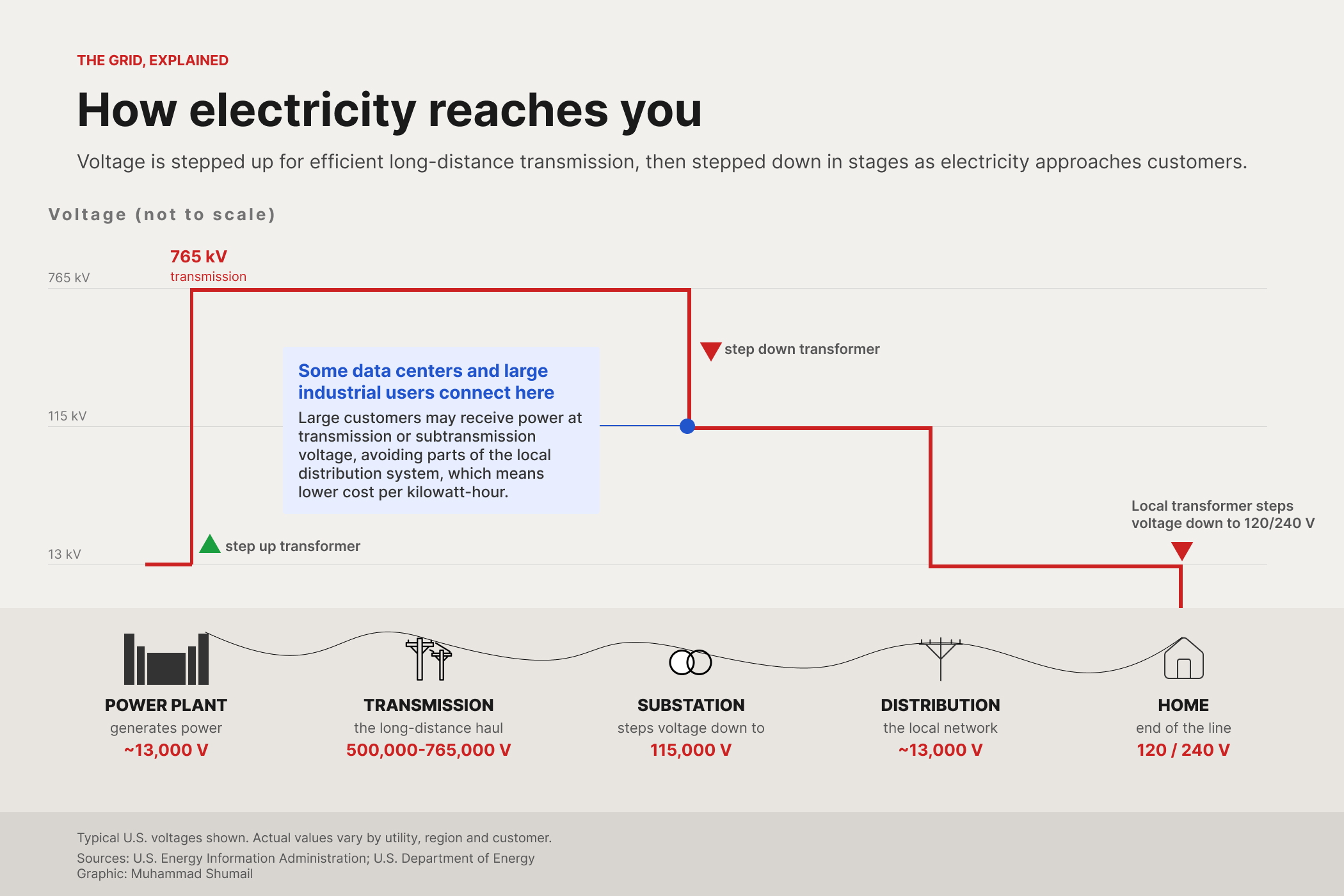
It's important to note, though, that Dominion does not independently set the price individual consumers pay for power; rather, it is formulated in a complex, regulated system that starts with power grid operators calculating supply and demand. From generators to distributors like Dominion to power lines to the overhead lights in an office building, there are several actors and steps involved in carrying electricity from its source to its final destination.
Various elements factor into what inevitably comes out of consumers' pocketbooks for their final electric bill, from the cost of infrastructure supporting the system to weather conditions affecting demand to the type of customer requesting the power. Industrial customers typically use more electricity and can receive it at higher voltages, so supplying it to them is more seamless and less costly.
Dominion leaders say the company is committed to protecting existing customers from cost shifts and ensuring large-load users contribute proportionally to the investments required to support their growth.
To be sure, large-load customers like data centers are going to start paying more soon in Virginia, thanks to a new rate class for those using high amounts of energy that's set to take effect next year. During a regulatory case this summer on Virginia transmission lines, however, Dominion pushed back on discussing cost allocation for large-load users, asking to table it.
Dominion owns approximately 6,800 miles of transmission lines in Virginia, North Carolina and West Virginia, according to a company report last year. For comparison, another national utility provider that operates in Virginia, American Electric Power Co., owns 40,000 miles of transmission lines.
Where are the data centers in Virginia?
Although it’s not clear exactly how many data centers are operational, in development or proposed in the commonwealth, there are roughly 371 operating in Virginia with a combined capacity of 17,378 megawatts and about 436 planned projects that would add another 37,140 megawatts of additional capacity, according to Cleanview, a company tracking data centers and other power infrastructure development.
In Prince William County alone, at least 55 data center buildings are complete, 30 are under construction, 51 are in the planning process and another dozen are going through land use applications, according to a county tracker.
The first data center completed in the county was the nearly 152,000-square-foot property at 7510 Mason King Court developed in the 1980s, municipal and CoStar data shows. While a few more became operational between the early 2000s and early 2010s, it wasn’t until about 2017 that data center development in the county really took off.
Fast-forward to the present, and it’s not always an easy path to get a thumbs-up to build a data center. Two of the largest proposed data center projects in the United States no longer are moving forward in Prince William County after its board denied a proposal for a 2,000-acre campus in July and, in the same month, the developer behind another seeking to build 37 data centers withdrew a legal appeal.
"If you had asked me back in 2014 when I started the coalition if I would ever have witnessed the evolution of this industry as a threat not just to western Prince William but, from my perspective, to the health of the world, I would say this would be fiction," Schlossberg, the citizen advocate, said.
Electricity usage by Virginia data centers rises
PJM Interconnection, the regional transmission organization that operates the electrical grid across 13 states in the Mid-Atlantic and D.C., expects the Dominion zone that covers Virginia to see "load," or demand, growth of 5.4% in the next decade, according to a long-term outlook it released at the start of the year. PJM had adjusted the tally to account for data center growth.

In other words, data centers are using increasing amounts of grid power. A dataset from the U.S. Energy Information Administration, the federal agency that tracks such data, confirms data centers are requesting more and more electricity.
Monthly sales of electricity to customers by sector in Virginia show in May that commercial users — which, according to the methodology for EIA’s dataset, includes data centers — utilized 7,233.95 million kilowatt-hours of electricity. That’s higher than six years earlier, when that figure stood at 3,881.26 million kilowatt-hours.
An exact breakdown within that EIA data of data center sales was not available, a spokesperson for the agency said. EIA is, however, launching multiple pilot studies to evaluate their energy consumption, including those in Northern Virginia.
But even with limits to the existing data, the agency has extrapolated that data centers have purchased the lion's share of electric power in Virginia.
One EIA analysis, in particular, supports that finding: Data centers concentrated in Northern Virginia increased commercial electricity sales in the commonwealth by nearly 30 million megawatt-hours between 2019 and 2025, more than in any state except Texas.
And electricity usage by data centers does not appear to be slowing down anytime soon. EIA's separate annual energy outlook projects that U.S. data servers will scale significantly to consume 581 billion kilowatt-hours of electricity in 2050.
Residential customers in Virginia, on the other hand, have more or less used a consistent amount of electricity. Usage inched up from 3,043.11 million kilowatt-hours in May 2020 to 3,080.02 million kilowatt-hours last May, EIA data shows. The data doesn't cite specific reasons for the increase.
So, are data centers driving up Virginia utility costs?

Data centers are using more and more electricity, but whether that is increasing costs for other customers depends on whom you ask.
Electricity prices typically reflect the cost to build, finance, maintain and operate power plants and the electricity grid, a complex system of power transmission and distribution lines, but it can also be reflective of demand, according to EIA.
Electricity prices also vary not only by where and when power is used but by the type of customer purchasing it.
The rate is usually highest for residential and commercial consumers because it costs more to distribute it to them, EIA says.
Data center load growth, however, is the primary reason for high prices, according to Monitoring Analytics, the independent market monitor of PJM.
The inclusion of data center load in the last three capacity auctions, in which distribution servicers like Dominion secure electricity supply for their customers, "increased customers’ bills by $20,036,670,606,” it said in its latest quarterly state of the market report published in August, even with an agreement in place for a price cap.
Had that price cap agreement not been in place, customer bills could have increased by more than $46.4 billion, the report said.
At the same time, the average residential retail price of electricity in Virginia, measured by cents per kilowatt-hour, has, in fact, risen in the past few decades.
Between 2001 and 2025, the average annual retail price in Virginia of electricity among residential properties rose from 7.79 cents per kilowatt-hour to 15.28 cents, the EIA data shows. Nationally, the increase was similar, from 8.58 cents to 17.3 cents.
The average annual retail price in Virginia for commercial properties in that time frame grew from 5.85 cents per kilowatt-hour to 9.55 cents, a 63% increase. Nationally, it rose from 7.92 to 13.41, a 69% jump, the EIA data shows.
Although measured in cents per kilowatt-hour, the increase in electricity rates can translate into significantly higher costs for customers over time. Critics contend that investments in new transmission infrastructure are helping drive those increases.
In a recent filing with the State Corporation Commission, which regulates Virginia utilities, Dominion Energy noted the share homeowners and renters pay for transmission costs has dropped about 27% over the past five years, while the cost to data centers has risen 148%, according to a WUSA9 article.
Michael Barber, senior energy infrastructure policy analyst for Virginia advocacy group Piedmont Environmental Council, said that's because data centers now make up more of the demand.
"Residential rates derived from transmission costs are still going up," Barber said. "There's still transmission that is largely only being built to serve data center customers. Data centers are paying more of those costs, but we wouldn't have any of those costs in the first place [if not for them]."
Virginia wants its say on who pays what
Ali Mehrizi-Sani, who directs the Power and Energy Center at Virginia Tech, one of the state’s largest research universities, told Homes.com News some of the public uproar that led to the new rate class by the Virginia State Corporation Commission, or SCC, is misplaced. “I know there’s a lot of public unhappiness about data centers [causing] the increase in electricity rates, but I don’t think there is real evidence they have done this already. We can’t really blame them,” he said.
That could change. A 2024 report on the impact of data centers by Virginia’s Joint Legislative Audit and Review Commission made clear that data centers are now the main driver of increasing electricity demand in the state. It forecast that a typical residential customer could see the share of costs for generating and delivering power rise by up to $33 per month by 2040 if demand continues to grow.
In response, the SCC, which regulates utility rates in Virginia, created that new rate class in November 2025 for “large load” customers, or those that consume 25 or more megawatts of power. Starting in 2027, most data centers will have to pay for “at least 85% of the transmission and distribution costs incurred to serve them each month, regardless of how much electricity the customer actually uses,” according to the SCC website.
Earlier this summer, Virginia Gov. Abigail Spanberger sent her chief energy officer to submit testimony to the SCC, indicating how concerned state leaders are about the data center backlash. In his testimony, the chief energy officer, Josephus Allmond, proposed that when a transmission line is being built only to meet a data center's needs, that those commercial users pay the full cost.
“To prevent cost-shifting to residential customers, appropriate safeguards must ensure that large-load customers pay their fair share for the grid infrastructure built to serve them,” he wrote.
A Dominion Energy official told regulators that large power users are already required to pay a greater share of transmission infrastructure costs. The official said Dominion is open to discussing additional ways to allocate costs in the future but argued that broader policy questions about who should pay for grid upgrades should be addressed in a separate proceeding.
At the end of July, the SCC issued a final order approving a rider — like a bonus fee — to help cover the cost of transmission infrastructure, but it is requiring data centers to pay for what's built largely for those facilities. It directed Dominion to draft a policy on the matter and file it within 90 days.
“This order — which is projected to save Virginians hundreds of millions of dollars — makes sure that data centers are paying the full cost of the transmission infrastructure their developments require," Spanberger said in a statement.
The decision came after Dominion proposed adding a rider to electricity bills to help it recover more than $1.5 billion associated with transmission costs in the coming year. That initially was expected to increase the bill for a typical residential customer using 1,000 kilowatt-hours by an estimated $2.90 per month. But under the approved order that shifts more responsibility to data centers, it's expected to increase the cost for a residential customer by only about 94 cents per month. The surcharge is set to take effect at the start of September.
Meanwhile, Spanberger said she wants to be a voice in connection with a proposed $67 billion merger between Florida-based utility group NextEra Energy and Dominion that is under regulatory review by the SCC. She says she does not intend to make the decision for the regulator, but if the deal is allowed, it could create the largest regulated electric utility in the world.
"When we file our amended line extension policy, we will be adding even more protections for our residential customers to ensure our more energy intensive customers continue to pay their fair share," Khan from Dominion told CoStar News via email in response to the SCC decision.
Pennsylvania regulators approved a similar standard in May, but it's in the form of guidance and is not necessarily binding on future utility decisions.
Effects cross state lines
The costs of new transmission lines to serve data centers in Northern Virginia aren’t borne solely by people and businesses in Virginia. A 2025 report by the Institute for Energy Economics and Financial Analysis forecast that ratepayers in West Virginia will pay more than $440 million over the next 40 years for two high-voltage transmission lines intended to carry power from that state to Virginia.
Most of the power will be consumed by data centers, the report said.
Both of those lines, with some transmission towers as high as 185 feet, would run through Lovettsville, a town in Northern Virginia’s Loudoun County where Theresa Ghiorzi lives. She’s become actively involved in efforts to pressure regulators to put the power lines underground. In an interview, she said she and others in her community succeeded in blocking a similar project in 2009, but that was before data centers started to be built in large numbers in her county.
“With the advent of data centers, they started throwing spaghetti at the wall, and everything that stuck, [the regulators] approved,” she said.
Virginia Tech's Mehrizi-Sani said that while data center growth could cause temporary bumps in what homeowners and renters pay for power, that will be because the power infrastructure hasn’t grown enough to accommodate the increased demand. Investing in new power generation and transmission lines should eventually bring rates down, he said, rather than causing ongoing increases.
“The economies of scale are going to make it cheaper,” he said. “Even if we see rates increase from data centers, to me it’s going to be a short-term impact, because more generation will bring costs down again.”
Barber of the Piedmont Environmental Council says there's reason to be skeptical of that claim.
"That is true if we look at the build-out of these data centers as a hump we're going to get over," he said. "We don't know if it's a hump. Dominion Energy has a backlog ... We're looking at building infrastructure for the next two decades."
This story was originally reported by Jonathan Lehrfeld and David Holtzman for Homes.com News.